Don’t bring this to the writers’ conference

A fellow writer on Twitter last week was looking for advice on how to make the most of  their first SCBWI conference. Plenty of folks had good suggestions. My contribution: Bring a shawl, it’s cold in hotel conference rooms. Because I focus on the logistics of things. And seriously, it’s cold in those conference rooms (even in June!).

But the question got me thinking, especially since registration for NJSCBWI’s conference is coming up this weekend. There are plenty of lists and tips out there about the many things you should bring to a conference (business cards, printout of your workshop schedule, notepads, money for the inevitable book-buying spree), so I thought I’d focus on what not to bring. Here’s what to leave at home:

  • Heels. Unless you’ve found the one miraculously comfortable pair of them in existence. You’ll be speed-walking from workshop to workshop to critique session to group critique session to roundtable to the book sales area to lunch to dinner to whew. Ditch the fancy unwalkable shoes.
  • Adorable small bag. It will adorably fail you. You’ll be toting around notepads, your schedule, manuscripts, workshop handouts, books, business cards, phone, possibly a laptop or tablet, definitely at least five pens, and—as I mentioned—a scarf, sweater, or shawl, in addition to whatever things you normally carry around with you. Which is why you need a tote. But even a tote can’t accommodate the following baggage …
  • Preconceived notions. You don’t know ahead of time how the weekend is going to go. You might get a manuscript request from an agent or editor, but you might not; there are no guarantees. You might see some familiar faces, or you might make some new writer and illustrator friends. You might find the inspiration you’ve been seeking to finish your work-in-progress, or you might inspire someone else to finish theirs. Be prepared for anything.
  • Unhelpful comments. You know the ones. “Oh, I’ve got a great idea for a children’s book! I’m just going to sit down and write it some weekend.” “So you ever going to make any money at this?” “That’s cute you write for kids! But when are you going to write a real book?” “But writing is just your hobby, right?” They’re not useful, they’re not true, you don’t need them. Leave them home, in the trash.
  • Imposter syndrome. Writers, artists, all manner of creative people—no matter their level of experience—play this awful mind trick on themselves: I’ve never done this before, I don’t have an MFA, everyone else has been published or they’ve been writing/drawing longer than me, I’m such a newbie, I’m not successful enough, I don’t belong here. Stop. If you’re taking your craft seriously enough to want to work on it and improve it and connect with other people working on their craft, you belong. Grab your tote and get in there.

If you’re attending a conference this year, I hope you have a wonderful experience and learn many things. And if you’re attending one with me, say hello.

Sharing creativity

My kids know I carry tiny purse-sized notebooks around to scribble out my rough drafts. (Moleskines are perfect—they’re the right size and they have built-in bookmarks and elastic closures—though WritersBlok notebooks are nice too.) This means they also know my works-in-progress are available if they get bored in a restaurant, waiting for their entree. Then they’re happy to provide feedback: “I like this. You should publish it.” “I read this part. Didn’t you finish it yet?” “WHAT. Why did you change it? I liked it before!”

Most recently—and yep, at a restaurant—my daughter flipped through the notebook to find a picture book idea I’d never finished. Because sometimes you start working through an idea, only to discover it isn’t working on the page as well as it did in your head. At that point you can 1. start over or 2. ditch it and focus your energies elsewhere, and that particular idea had been ditched. My daughter disagreed with my conclusion. In fact, she thought she knew how to end it, and could she write the ending? I said sure.

So she borrowed my pen and wrote the rest of the story. She got exactly the idea I’d been going for, too. And now I have written proof that she thinks highly enough of my work to want to be part of it.

Of course, she’s already appointed herself editor of all my work and has offered to illustrate it. So she’s a little ambitious.

The other day, I needed to bring my son with me to the coffee shop; he had his magazine and a muffin, I had a scone and revising to do. Once he realized what I was working on, he craned his head to see my screen. Then he moved to my other side to read my notes before I’d even gotten them typed in. Then when I was done, he asked to read something else. At which point I ceded control of my laptop and let him read my novel till it was time to go.

Sharing my work with them has been one of the best things about writing kidlit, not just because they like reading it but because they’re pretty creative in their own right. Both of them create their own comics. Both of them make art, everything from paper sculpture to pottery. It’s such a pleasure to see them expressing themselves. And maybe, possibly, they’re encouraged by watching me.

I don’t know where this creative path is going to land us, but I’m enjoying the journey.

Working big to small

Between two book editing projects, a few smaller editing projects, my usual newspaper gig, and a case study, August was unexpectedly busy. But here I am, and I’m looking forward to more busy-ness in September (as well as a break from all the heat advisories).

In the meantime, I’ve been revising a few stories of my own as well as working on the next story, and beginning research for the story after that. And I keep relying on advice from my drawing teacher.

Nope, I am not a professional artist. I have just enough talent to know how much more I would need to be a professional artist. But I love art in all its forms, from gallery paintings to comics, and I take art classes for fun. My teacher for the past few sessions is an excellent artist, helpful in all aspects of technique, and there are a few things he says regularly. One is that you have to study an object pretty thoroughly before you can draw it, instead of just glancing at it and rushing your pencil into action. Another is that you need to work “big to small”—that is, sketch in the big shapes first, figure out where all pieces are in relation to each other, then start to add in the details.

Turns out his advice works pretty well for writing, too. Even pantsers—and I am definitely a pantser—have to know a few basics before they start writing in earnest. Be a reporter: Know the who, what, when, where, why, and how. In other words, study before you draw.

And work out the character arcs, plot, beginning, and ending before you stress about the color of the curtains in the living room, or whether you’re using the right word to describe the sound of your protagonist’s voice in one scene. Sketch in the most important things first, and swing back later for the details. Work big to small.

I didn’t expect to get good writing advice from art class, but I’m calling it an extra-credit lesson, and will use it to the fullest.

Happy reading and writing this month.

On being a generalist

I’ve attended the occasional business networking event where other attendees have taken it upon themselves to critique my business model. “You’re too all over the place,” they say. “You should specialize in something.”

Those other attendees, of course, weren’t writers.

As a journalist and assigning editor, I’ve had to become knowledgeable about a lot of different topics pretty quickly. This means I have 1. ferocious focus, 2. strong research skills, and 3. a constant sense of curiosity about practically everything.

Just in the past few years, I’ve written about real estate and home design, agriculture, health care, hearing issues, wine production, art, computer theft, and the Caldecott/Newbery awards. (And that’s just the day job/nonfiction side of my work.) I like the variety because I like learning new things and hearing such a wide variety of stories, because that knowledge will make my fiction writing and editing even richer.

There absolutely are writers and editors who specialize in a particular industry or a specific topic, and that’s fine. I may eventually decide to go that route. But being a generalist is also a valid choice and can lead you down any manner of interesting pathways.

And those networking events? I haven’t attended any lately. I’ve been a little busy.

Write/edit/revise/repeat

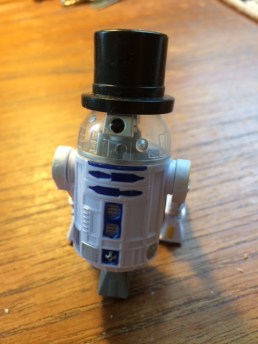
First of all, May the Fourth be with you!

IMG_2872.JPG

Yes, my droid wears a top hat. He is fancy.

Second, it’s been a busy month.

I wanted to revise my MG novel-in-progress so that I could submit the revised version for a critique at the upcoming NJSCBWI conference. My beta readers had given me great feedback, I’d done some more research, and I knew a whole lot of things I needed to add. Meantime, I also had my usual daily and weekly deadlines for the various editing and writing projects that make up my day job. So I worked on those projects during the day, then revised the novel at night. All month.

This was a fairly doable thing. It was a matter of mindset, and minding the time. I’d spend mornings on one article or editing gig, break for lunch, switch gears to another project, then switch gears again at night and work on the novel. Working on one thing continuously for all that time might have gotten exasperating, but flipping to different projects kept me sharp.

I don’t think multitasking actually exists, at least the way people think of when they use the term. But I think you can finish anything if you work on it an hour (or two) at a time.

I made all my deadlines, including the submission date for SCBWI, and then I spent a day remembering what TV looks like.

And then I flipped back to the first draft of another novel-in-progress. But now I get to take my time a little more.

Bringing the news offline

I’d share some of the articles I’ve been writing lately, but I can’t.

Or more precisely, won’t.

Here’s the deal. One of my regular gigs is writing and editing (and setting up photos and working with reporters and helping keep things moving) at this local newspaper. You’ll note there are no articles posted on the website. There never are. The paper is print-only. And I’m glad.

Back in the ’90s, when newspapers decided they needed websites, the orders came down to put all articles on the website. For free. And I thought, “But why would anyone buy the paper if they can read the whole thing for free online?” Alas, I was a lowly copy editor and who cared what I thought.

So we put everything online. For free. Even though newspaper circulation had already been slipping downward for a while, and Generations X (that’s me), Y, Z, Z-plus and whatever else they’re going with these days didn’t have the daily newspaper habit their parents and grandparents did. Even though Craigslist and eBay came along to corner the market on classifieds. Even though advertising started to slip and the cost of newsprint went up. (This article in The Atlantic is a good summation.)

So newspapers lost money, and fired staffers to save money, and lost more money, and got thinner and thinner, with less and less news in them.

The past couple years have been good for the bigger papers, bringing a surge in digital subscriptions. But as the Pew Research Center points out, the industry overall is still suffering.

Now, I’m a book-nerd. Most of my goals for the future involve writing books and working with authors on their books. But I also love newspapers, and have ever since I joined (and later ran) my college newspaper. Newspapers, with a few exceptions, are still the best place to find good journalism. But I’ve been watching colleagues lose their jobs for some time now, and I’ve grown increasingly worried that good journalism is going to disappear with them.

So I was delighted when a colleague of mine announced he was launching his own local paper and looking for freelancers.

Every time I interview someone for an article, about the town food pantry’s plans for outreach or the changes to this year’s arts festival or the expansion of the Middlesex Greenway, they tell me how great the paper is and how glad they are to have a local paper. At the end of one recent interview—which happened to be at a church—the monsignor even blessed me, which was a first. I will definitely take my blessings where I can get them.

And none of these articles is online, because my colleague wants people to buy the paper. Not read it for free.

And frankly, I do too. I want this paper to keep going, because I think this level of local news is what’s missing from most papers now—they don’t have the staff, they don’t have the money, they don’t have the time, etc. I think this is how newspapers survive and thrive: By staying local, and by consistently charging for content. Because I don’t work for free, and neither should anyone else who writes, edits, takes photos, or does graphic design for a living.

So if you want to see what I’ve been working on lately, I’m afraid you’ll have to buy the paper. But trust me: It’s worth it.

Typos matter

I cringe at “speciality.” I groan at “reigning them in.” And when I see “traveling though the town,” I want to throw things.

I see errors like this constantly: in newspapers, in published books, on restaurant menus, on product packages, in the tickers across the screen on news channels, even on storefront signs. I can’t switch off my editor’s eye, so I get regular reminders that people don’t write or type as well as they think they do. (Or that they need to hire an editor.)

Does it matter? Of course it matters. For one thing, people might judge you by your typos. Check out this study by University of Michigan researchers that found people reacted more negatively to emails with errors in them. A good part of my job consists of emailing people about being interviewed for an article or setting up a photo for that article, or else emailing writers about possible editing work. These people don’t know me; all they have to go on is my email, and if that email contains misspellings or poor grammar, they have less reason to take me seriously.

For another, errors and unclear language can cause unnecessary confusion and even cost money. Just ask the dairy drivers in Maine who won a labor dispute case over the lack of an Oxford comma.

You can absolutely be a good writer and still commit typos, or be a terrible writer who spells and punctuates everything correctly. (I’ve dealt with both.) But if the entire point of writing is to communicate with other people, shouldn’t you want to do that as clearly and as accurately as possible—for your readers’ sake, as well as yours?

If nothing else, you’ll have my undying gratitude.

Vacation and idea generation

The family went on vacation last week to … let’s say it was warmer there, with lots of mouse ears? It was a fine time. But January is also StoryStorm, the annual story idea marathon hosted by Tara Lazar that features inspirational posts plus a few prizes (see here for details), which I’ve been participating in for several years. No worries, I thought. I’ll bring my notebook with me, along with my manuscript-in-progress. I’ll get work done on the plane. I’ll think creative thoughts while waiting on line for rides. It’ll be a productive, fabulous time.

Except not.

Turns out I’d underestimated the buildup of mental noise after a day full of lines/rides/crowds/shopping/keeping wandering kids from disappearing/shows/way too much food. At the end of the day, the only thing I was capable of was zoning out at the hotel while watching “Star vs. the Forces of Evil.”

I had no story ideas. My brain was blank for a week.

I’d forgotten the most essential element of creativity: the quiet calm space to escape into your own head for a while. If you’re running around, your mind can’t wander.

On the other hand, sometimes a break from creativity is what you need to recharge. Now that we’re back, I’m steadily catching up and about to cross the finish line.

And I did get some work done on my manuscript. So that’s a win!

Why I freelance

At the end of October, I had eye surgery. I was supposed to be resting afterward.

I did, sort of, until I got a developmental editing project, a bunch of articles to write and edit, a few rush-job editing projects, a health care communications project …

And in the middle of all that, I finished a rough draft of my novel-in-progress.

So, November was busy. My eye hasn’t exploded, fortunately.

I’d always rather be busy than unbusy, so I’m not complaining (but don’t tell my ophthalmologist what I was up to). Theoretically things have slowed down for the moment, but sometimes the freelance life means not knowing what your day is going to look like until you switch on the computer that morning.

Turns out I like that freeform sort of flow, since I can also, say, duck out to volunteer at my daughter’s holiday boutique (she demanded I look the other way while she was shopping for me) or take my son to Cub Scouts, while still meeting deadlines. Or run over to the farm during CSA season to pick up our share of produce. Or meet a friend for lunch and a write-in. None of that was possible when I was stuck in an office for eight-plus hours a day, then stuck in traffic for another hour-plus, so I do appreciate the freedom. (Especially considering how many hours I also spent last month sitting at the eye doctor’s office.)

It’s not the life for everyone—you have no co-workers to gossip with/about, and if you’re having computer problems you can’t exactly call the IT department—but I concentrate better when it’s quiet. This sounds like a paradox, considering I spent 20 years in noisy newsrooms, but I got pretty good at tuning out the phone chatter, TVs perpetually blaring news updates, and other assorted white noise; now, I don’t have to. I can just focus.

So I’m not sure yet what December is going to be like, but it’ll be fun to find out.

What I’m reading: I’ve gotten slightly obsessed with “Giant Days,” the off-the-wall, goofball story of three friends and roommates trying to survive both college and romance troubles, which is both hilarious and beautifully illustrated. (Side note: Apparently I’m going to read every comic book Boom! Box publishes because that’s how it is.)

41PzrZIw8iL.jpg

I don’t let the kids read this one, because there’s a fair amount of sex- and drug-related humor—the characters are in college, remember—and even though the dialogue does an amazing job of hinting at what everyone is talking about without ever being graphic or explicit, I’d rather wait until the kids are closer to YA-level age. Still, so few TV shows, movies or books really get at the sort of confusion, questioning, and small steps toward adulthood that happen in college; this comic comes pretty close. And bonus, it’s set in England, so you get to imagine all the dialogue with British accents.

And I just finished “Posted” by John David Anderson, which unsurprisingly is amazing, because “Ms. Bixby’s Last Day” was also amazing and made me cry. Anderson is great at detailed, lyrical storytelling that somehow still sounds like it’s coming from a tweenage boy.

51W2QGh17bL.jpg

It’s about what happens at one middle school after phones are banned and kids grab sticky notes to send messages to each other instead, and how even that low-tech system spins wildly out of control when kids start to use the notes for attacks and insults. It’s also about how a change in social status can wreck a solid-seeming friendship. Plus plenty of Dungeons & Dragons jokes for this former D&D player. My one note, and it’s a minor note, is that when Frost, the main character, describes himself as “part of the chorus” in the beginning, it’s a little too accurate; he’s a thoughtful observer of everything happening around him, but he isn’t exactly driving the action until close to the end, and the main drama centers around two other characters. Still, the book is well worth reading, especially for kids who’ve had their own experiences with bullying, online, offline, or through mean little notes.

Talking to writers

For the first time, I set up shop at a writers conference as an editor-for-hire, claiming a table at the recent New Jersey Romance Writers’ Trade Expo. And it was fun.

I wasn’t able to attend the actual conference (next year!) but looking over the schedule, I was struck by how similar the workshops were to what I’d seen at other conferences: focusing on plot and characterization, marketing your work, learning the ins and outs of the publishing industry. And the other conferences I’ve attended have been either general/all genres, or kidlit-specific.

I opted for candy over swag, per the suggestion of Jennifer Lawler, whose developmental editing classes I’ve been taking through the Editorial Freelancers Association (I highly recommend her classes, and she’s fun to follow on Twitter, too: @JenniferLawler). But I decided to have some fun with it and set out three bowls: regular candy, nut-free candy, and sugar-free candy, with the sign “An editor checks the details.” It got a couple of laughs, which was what I wanted. (For the record, no one took the sugar-free candy.) I had leftovers, but conveniently it’s Halloween, and we get a crowd of trick-or-treaters.

I did worry that I would be sitting there the whole time staring nervously into space, but a steady stream of people stopped to say hello and take my info. And it struck me all over again how universal the conference experience is for writers. I asked everyone how the conference had gone for them, and I got the expected range of answers. One attendee pitched a few manuscripts and had gotten five requests, which is amazing. Another was at her first conference ever and had developed a bit of a deer-in-headlights look; I told her to go relax and take in everything she’d learned. I loved hearing about everyone’s successes, what they were working on, what they were doing next.

The whole experience was a useful reminder that we’re all learning the same things, no matter what we write, and no one is going to understand the process better than another writer.

It was a nice time, and I do appreciate the NJRW for having me. I hope the attendees have success stories to share next year, and I hope to be there to hear them.