Super Copy Editors is where I do a fair amount of my freelance work—it’s a great company, and founder Dave Baker is a pleasure to work with. He interviews one team member every month for the company newsletter, and I enjoyed the interview so much I requested to share it. So here it is, for your reading pleasure. Have a lovely week.
In person, again
I thought I’d remembered everything about in-person writers’ conferences. Bring a scarf or wrap. Wear comfortable shoes. Bring a notepad and pen for when you get good advice or when inspiration strikes. Caffeinate regularly. But nope, I forgot that the air conditioning would also be intense enough to affect my feet. I spent half the day thinking sandals, ugh, where are my sneakers? Listen, it’s been a few years.

I’ve spent most of this year feeling like we were finally easing back into something more or less resembling regular life. We restarted our annual Super Bowl party. I started leaving the house without a mask in my bag. We hung around older family members without worrying about anyone’s exposure levels. And NJ SCBWI held an in-person conference again.
I’m glad there are more virtual options out there now for conferences, workshops, and webinars. They’re a lifeline for people who can’t travel, who need disability accommodations, or who are immunocompromised. But I never feel fully connected to people through a screen. I’m the sort of introvert who works best in one-on-one interactions, where I can see the other person’s face and hear their voice. Without that, I feel like I’m missing vital information. With that—well, every writer friend I have is someone I met at a conference or other event. One of those friends led me to my critique group. I’ve gotten editing work through writer friends, I’ve gotten feedback that helped me improve my own work, and I hope I’ve helped other people improve theirs. More intangibly, I’ve developed a sense of belonging. When I walked into the conference building, I saw people I knew, people I hadn’t seen in person in years. It felt like a homecoming. And that alone was worth the price of admission.
So thanks to NJ SCBWI for putting the event together (standouts for me: Andrea Loney’s “Creator Care” presentation and Yvonne Ventresca’s workshop on revision tools and techniques), and thanks to Montclair University for hosting. I was really grateful to be around my fellow creatives again. Even with cold feet.
(But please keep the coffee coming next time! I really do caffeinate continuously.)
Finding a critique group
My primary critique group is kidlit-only and everyone in it is fabulous. But since they are kidlit-only, I couldn’t bring them the short stories I increasingly write for adults. Especially since some of those stories are horror. Picture books don’t exactly go along with, um, carnage. (Unless the picture book is “I Want My Hat Back,” but that’s probably an exception.)
So I went looking for a secondary critique group for my short stories/novellas/whatever else I decide to write for adults. Finding a group can be the easiest and the hardest thing to do. Because while there are writers’ groups, both in-person and online, that advertise for new members, and there are plenty of places around social media where you can link up with potential critique partners, you don’t want just any group. You want the group that makes the most sense for you.
First of all, there’s a difference between support groups and critique groups. With a support group, you can get together and vent. You can talk about how tough the industry is. You can lift each other up, help each other to keep pursuing their creative dreams. Support groups are good for the soul and your sanity. (I have one of these groups, too! I recommend them.) But they don’t help you improve your writing.
Critique groups are specifically focused on the craft. You meet to read and discuss each other’s work, whether that’s a complete story, an excerpt of a longer work, or a full novel. There are plenty of guidelines out there for how to do this professionally—in other words, how to give useful feedback without being a jerk. This post has some good suggestions, for instance.
My point isn’t so much the mechanics of critiquing, though. It’s making sure you and the group are aligned. Are you all looking to get published? Are you all writing in the same, similar, or complementary genres? How much time are you able to devote to writing and revising each month? Can you all commit to meeting and providing feedback regularly? Will each member of the group get equal time to share their work?
Here are some of the reasons I’ve seen critique groups fall apart. A member never actually finishes any manuscript—they keep rewriting chapter one over and over. One prolific member insists on their work being read constantly, ignoring the needs of other members, until they entirely overtake the group. Members are perpetually too busy to commit to regular meetings or to write anything new. Members are either hostile to constructive criticism or incapable of giving constructive criticism. You need structure, you need consistency, you need everyone working toward the same goal—even if they’re each doing so in their own way.
When you’re looking for a group, audition it. Attend a few meetings, try to get a sense of what the other members are like. Make sure their level of commitment is similar to yours. They’ll likely be evaluating you as well. The right fit benefits everyone.
As for me, I found a new group through Uncharted magazine, which organized a digital critique group meetup. They’ve only done this once so far, but maybe they’ll do a round two at some point? Otherwise, if you’re in need of a critique group, check the official sites of writers’ organizations and poke around social media. You’re bound to find something. Good luck and keep writing.
On persevering
I sold three short stories last month. One sale was a reprint of the first short story I’d ever written. One was the second time I’d submitted that story anywhere. And the third was a story I’d been trying to get placed for at least a year and had been racking up rejections for my trouble. All three sales made me happy (especially the one I got emailed about on my vacation. Pretty good reason to justify checking my email in the middle of Animal Kingdom!). I can’t wait for readers to see these stories. In fact, you can read one of them now.
There are a couple of conclusions to draw here. First, obviously, is that the submission process for short stories is fairly subjective, and sometimes you need to keep trying to find the editor who loves your work. Second, you can’t take rejection personally, although you’re still allowed to hate it. (I find chocolate is helpful in these situations.) Third—most important—getting your stories out there is a numbers game. The more you submit, the more likely you are to get acceptances. You can’t win if you don’t play.
A reminder: Getting an encouraging rejection letter with helpful feedback also counts as a win. An editor asking to see more of your work? Definitely a win. Dusting yourself off after a discouraging rejection and sending that story somewhere else? That’s a win too.
I’m waiting to hear back on a couple of other short stories. They’ll get accepted or they won’t. If they’re not accepted, I’ll try again.
This process takes a lot of work and time, which can be a little frustrating if you also have a day job (what do I do at my day job? Articles like this, among other things). But it’s work that’s worth doing, and it’s for you. The only expectations you have to meet are the ones you set for yourself.
Keep writing, keep submitting, keep persevering.
Back to work, back to life
*Taps mic* I think this thing is still on, right?
So, it’s been an interesting few months. I left my freelance career for a full-time job, and that job let me go after a year. I thought an agent was interested in representing my book, but she apparently changed her mind before I ever sent her the revisions she requested. And I quit the critique group I’d been testing out over excessive mansplaining.
And that was just *September*.
I started rebuilding my freelance work, I sent out more queries, I submitted more short stories. I collected more rejections. Then I finally got Covid. Happy holidays!
(I’m fine. It was mild.)
So here I am, starting over in every way possible. That’s not necessarily a bad thing. I got to do two library presentations last year and it was fun. I did finally catch up on my reading, including this fundraiser anthology, which is phenomenal, and this cool-as-heck Jewish anthology, which I joined the Kickstarter for. I’m waiting on a contract for a short story. I’ll spend the month planning out the year as I keep working to get my middle grade novel published. Plus the other short story and the novella I’m working on. You never know which seeds are going to sprout into something beautiful.
I hope you also have a creative January. Stay healthy out there.
Talking about antisemitism
Let’s see, we started last week talking about Dave Chappelle and ended it with two armed men arrested at Penn Station after allegedly making threats against the Jewish community. In between those incidents, swastika graffiti was found near a public trail in Maryland, a Jewish cemetery was vandalized with swastikas in Illinois, and antisemitic flyers were left in neighborhoods in various parts of Rhode Island (see the ADL’s antisemitic incident tracker for details/news links). And those are just the incidents I know about from last week, not including the man whose alleged threats put all New Jersey synagogues on alert until he was arrested.
I could say I’m horrified and we live in scary times and we need to oppose hatred. And all of that is true. But I think it’s more useful to share information. When people can put events and wrongheaded beliefs into a larger historical and cultural context, then they can better understand what’s happening. Then they’re better equipped to fight it.
So let’s talk about an antisemitic trope. Specifically, the Jews-control-things trope. Historically speaking, Jews have tended to cluster in specific industries or careers because we either weren’t welcome in or were barred from the others. This is where the European Jewish moneylender or peddler stereotype comes from (although some academics think that the stereotype might be overstated). Similarly, Hollywood movie studios were mostly founded by recent Jewish immigrants who would’ve been kept out of other, more established industries. And many early comic book creators were Jewish because they couldn’t get work in more mainstream art fields. When Jews do well in a particular industry, people accuse them of “controlling” it.
Having a bunch of Jews in an industry is not the same thing as Jews controlling that industry. But attacking Jews for “controlling” an industry sounds very much like saying Jews shouldn’t be in that industry at all.
The thing about tropes like this is, people get used to hearing them and then don’t question them. They become “conventional wisdom.” That’s how hatred thrives in plain sight.
In the library presentation I did recently, I talked about my short story “Clearing the Field” (in this anthology if you’re interested). It’s about a young baseball player who sees spectral Nazis on the ballfield. But she’s the only Jewish player, and she’s the only one who sees them. The field, she discovers, is the site of a former American Nazi camp. Eventually the Nazis start menacing her dreams, and she realizes she has to find a way to exorcise the hateful memories of the field for good.
Where did I get the idea from? The knowledge that there were not one but three such camps in New Jersey before the U.S. entered World War II. This is from my presentation:
- The German American Bund was a pro-Nazi organization active in the 1930s until the U.S. entered World War II, after which it was outlawed. In addition to the Madison Square Garden rally it infamously held in 1939, it ran a number of youth camps throughout the U.S. There were several camps in the area: Camp Siegfried on Long Island, Camp Bergwald in Bloomingdale, Camp Wille und Macht in Griggstown, and Camp Nordland in Andover.
- Camp Nordland quickly became unpopular with the locals. It was the frequent site of protests, and the county sheriff began to investigate it. The state revoked its charter in 1941. The former campsite is currently used for recreational fields.
- An off-Broadway play about Camp Siegfried, written by Bess Wohl, opens Nov. 15, and a historical novel about Camp Nordland by Barbara Krasner will be published next year.
I think people like to view white supremacy and American Nazis as a new problem. That’s just not the case. But people have to be willing to see what’s right in front of them.
If you’ve read this far, please check out this GoFundMe list to help victims and families of the Club Q shootings in Colorado. I don’t need to point out that hate speech against LGBTQ people has also been increasing over the past few years. We could do a lot about hate speech, and hate crimes, if we kept showing up for each other.
Should I stay or …
… should I jump from the apparently-sinking ship that is Twitter? A lot of people seem to be asking that question. A lot more have already answered it, judging from the dwindling number of names I recognize on my feed.
I don’t think there’s an easy answer. It was already a Dumpster fire much of the time. But it was also a place for me to cheer on my writer friends and learn about agents opening to queries or about short fiction submission opportunities. It was people who don’t know each other IRL perpetually fighting each other because one of them had an opinion on something. It was a place to learn about life experiences and viewpoints I might not have gotten exposed to otherwise. It was frequently racist, sexist, antisemitic and awful, but still somehow a requirement for creatives looking to “build their platforms.” It was a way for small businesses and entrepreneurs to get their work seen and boost their profiles.
Plus, cat photos.
I probably won’t actively quit. I’ll keep checking in on the people I know until the day I try to open the site and it’s not there. But I really, really would like if there were another place to have these conversations, minus (at least some of) the hatred. I’m not sure Mastodon is it (convince me otherwise). I’m dubious about Tumblr. If I fully switch to Instagram, it’ll be all cat photos all the time. Which is maybe not super professional.
Some cranky part of me wishes we didn’t need to rely on social media at all. It seems to amplify the negative and bury the positive, and I think that’s a feature, not a bug.
Aaannnddd speaking of antisemitism because it’s increasingly unavoidable, the Forward generally has a more informed, nuanced take on such incidents than other outlets. For instance, this column about Dave Chappelle’s SNL monologue. But look, I get way more worried when politicians spread antisemitic tropes than when celebrities do it. Celebrities don’t make policy.
So, see you on Twitter, maybe, and if not, stay safe.
Speaking out
When I started writing my novel about a girl who creates a golem to protect her from antisemitism, I based it in part on my own experiences as a kid living in a very not-Jewish area. The penny-throwing. The name-calling. Needing to miss school to celebrate the High Holy Days. Getting mocked for bringing matzoh to school during Passover. That kind of thing. Since the story has a (mostly) contemporary setting, I folded in some things that echoed current news events.
Then eleven people were shot to death in a Pittsburgh synagogue, and it wrecked me. Four years ago today. And my frustration and anger have only grown since then as antisemitic incidents and language have increased across the US. I would much rather have watched my novel become less relevant, not more relevant. Querying it is … a lot, sometimes.
But I also see people speaking out against this particular form of hatred, and recognizing how intertwined it is with other forms of hatred. And that’s so important, and so much appreciated.
So what can you do to help? Recognizing and calling out antisemitic tropes is big. The ADL explains the historical roots of these tropes and how they can appear in a modern context. A Europe-based site called Get the Trolls Out! tackles religious hate speech in general, and it has a fairly comprehensive section on antisemitism.
CNN did a special about antisemitism over the summer, which you should still be able to find on-demand.
If you read YA, check out Liza Wiemer’s The Assignment. It’s based on a real-life incident involving a Holocaust-related assignment at a high school that required students to debate “both sides” of murdering Jews.
Ken Burns’ latest series focuses on the US response to the Holocaust. And HBO just released a film chronicling the aftermath of the Pittsburgh shooting and how it affected the community.
Knowledge helps defeat hate. Thanks for listening.
My book presentation!

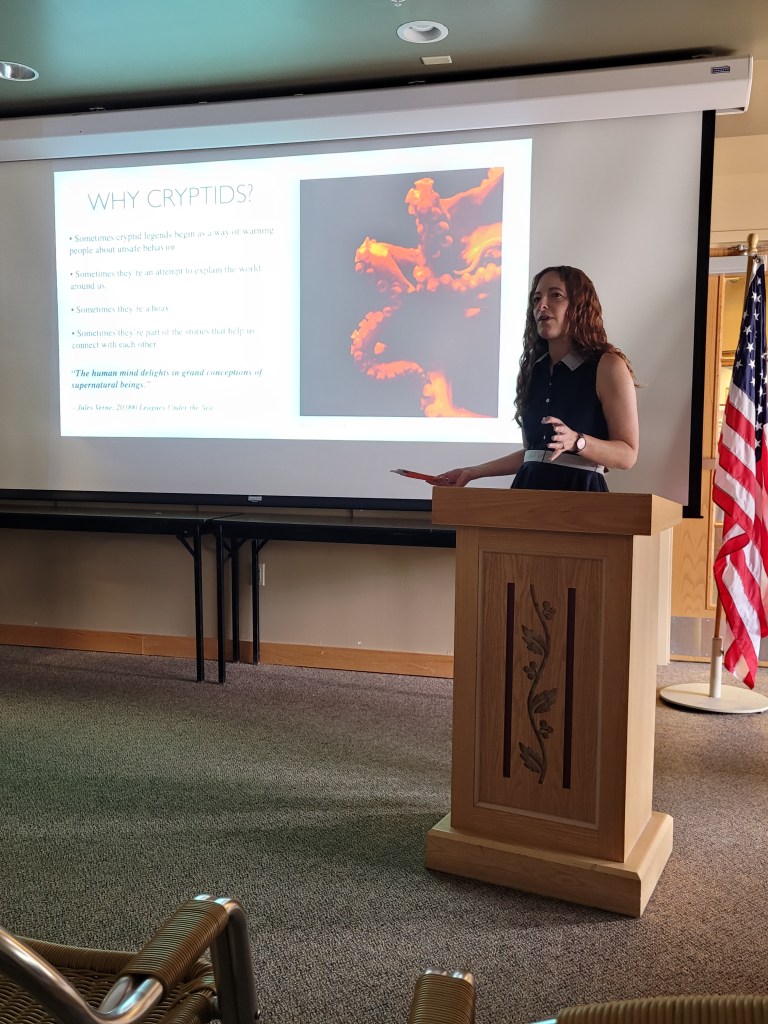
Since one of the anthologies I have a short story in, Dark Cheer: Cryptids Emerging, Volume Silver, happens to be all about cryptids—meaning supernatural creatures from folklore/mythology—my library asked if I would do a presentation about water-based cryptids. This went along with the theme of the library’s summer reading program, “Oceans of Possibilities,” as well as with my cryptid story, which is about an extremely tiny Leviathan (a Biblical cryptid!). So obviously I said yes.
To tie this talk into books and reading, along with explaining where these legends originated and how they likely got started, I offered book recommendations for each cryptid. Some were obvious (of course “The Little Mermaid,” although there are always people who’ve seen the movie but haven’t read the story) and some maybe less so (China Mieville’s Kraken, which is epically off the wall).
It was great fun to research and put together, and I think it went off pretty well. Plus I got to drag out one of my cute work dresses instead of my usual remote-work outfit: a non-logo T-shirt that shows up nicely on Zoom calls, jeans, and Crocs sandals.
I learned a couple of things that I’ll remember for next time:
• Bring a water bottle, so you don’t spend the entire talk worrying that your voice is going to die on you.
• Remember that everyone knows what the Loch Ness Monster and mermaids are, but not everyone knows the word cryptid. You might need to correct someone when they say, “… crypto?”
• Practice using the tech in advance, so you’re not staring at your Square reader thinking oh no please work when you try to sell copies of the anthology.
• Maybe make sure the library front desk knows about the event? That way when people call to confirm it’s happening, they don’t get a confused response.
• Make sure you have someone to advance the slides for you, because it makes your job easier, and that way you don’t have to get your kid to do it last-minute.
• Try not to have your event coincide with your kid’s troop doing an Eagle Scout project outside, because he’ll keep sneaking out to grab extra doughnuts from them.
But everyone seemed to enjoy the presentation and I got some nice support from family and friends, including some critique group members I haven’t seen in a long time or have never gotten to meet in person. Thank you all for coming!
And if any other groups would like to learn all about kelpies, selkies, and other watery magical creatures, I’ve got a fun slideshow for you.
Two years
Two years ago, the last in-public thing I did was volunteer at my kid’s Girl Scout troop cookie stand. (Those things sell themselves. It’s incredible. People ran across the parking lot, yelling, “THERE you are! I’ll take twelve boxes!”)
There were already COVID cases in New Jersey. Just a couple. Then a few more. And still more. Events started to get canceled (the troop never did take that trip to the Statue of Liberty). I was going to physical therapy for my recently diagnosed disembarkment syndrome, aka MdDS; I canceled my next appointment, because most of the other patients were older and I thought I might somehow endanger them, as though the virus were already everywhere around us. My neighbor and I, on the way back from the bus stop, spoke worriedly about rising case numbers. We were sure the schools were about to close. A day later, we were right. Friday the 13th.
But hey, we could handle this for a couple of weeks, right?
HAHAHAHAHA.
Two years. In New Jersey alone, over 30,000 dead. Hospitalizations keep dropping now, which is great, although the rate of transmission has been ticking back up (not sure how to read that anymore). Fewer and fewer people wearing masks in stores. People talking about “moving on” and “getting back to normal” when I’m not sure anyone understands what “normal” should look like anymore.
Meanwhile, there is a horror show in Ukraine, and people who are “different” (transgender kids and Asian-Americans, for instance) are under increased harassment and attack across the U.S. I hope that’s not what anyone meant by “normal.”
Side note: It’s increasingly frustrating to be querying a novel about a golem fighting antisemitism as actual cases of antisemitism keep rising.
It is totally fine, right now, to not be fine. Things are not fine. None of what’s happening is right, and there are millions of people dead worldwide because of a literal plague that isn’t *actually* over yet, although I hope we’re getting there.
I handle things by making donations to various advocacy/Ukraine aid groups, signing petitions, looking for ways to help people. Not sure it’s enough, but it’s something. When I can, I write. However you’re coping is fine, too.
Two years. But there’s still time to work for better things ahead.