Notes from an editor

A newsroom colleague asked me once why I would want to run a newspaper. “To make it better,” I said. He nodded respectfully.

I’m not much interested in running newspapers these days (though I do still write for them on occasion), but I think my answer still applies to editing in general. Why be an editor? To make something better.

I’ve been editing professionally for a long time—copy editing, proofreading, and now moving into developmental editing. I’ve edited breaking news on deadline, fiction and nonfiction manuscripts, movie reviews, and obituaries. I get equally annoyed by typos in books, on restaurant menus, on shoebox packaging, and in TV news crawls. (Every single news channel has typos. This is a bipartisan aggravation.) I analyze while reading. It’s a habit.

I’ve worked with a lot of writers, and in my experience, these are the elements crucial to the success of the writer-editor relationship.

Trust. Though that trust can be unnerving. Frequently I’d tell a reporter I’d tweaked parts of their article and offer to show them the changes, and they’d just shrug and say, “I trust you.” Then I’d neurotically wonder whether I should make them read the tweaks anyway.

They trusted me because they knew I wanted to help them produce their best work. They knew I wasn’t going to change things that didn’t need changing or throw in words they would never use (every writer has a “stable” of words they use most often; if you add words that don’t blend with the rest because they’re too flowery or esoteric, you’ve muddied the voice). They knew I was keeping their viewpoint in mind. And they knew I was neurotic enough to make them read the changes.

Understanding. It’s not just doing your job well—it’s understanding how the other person does their job. When editing a newspaper or magazine article, I knew the reporter had spent hours, sometimes days, collecting enough research to put an article together, and even more hours figuring out the puzzle of arranging the article. When I’ve beta read or critiqued fiction, I’ve kept in mind how much work went into planning out the elements of plot, character, voice, and theme. I respect what it took for the writer to complete their work, and I respect that changing that work might not be easy.

At the same time, the best writers I’ve worked with understood that it took time for me to do my job and that I couldn’t just skim something, run spell check, and call it done.

Knowledge. If I’m not familiar with the writer’s subject matter, I’ll take the time to get familiar, because I think research is fun. (Yes, I’m nerdy. And?) I know what it feels like when the person editing or critiquing your work hasn’t done their homework. During a writers conference held at my college, the critiquer admitted that he wasn’t familiar with science fiction, and proceeded to mumble his way through some vague commentary on my short story. Was my story any good? Probably not. But the critiquer didn’t offer any suggestions for making it better, and I felt out of place for even asking.

I don’t think there’s any shame in looking up something you don’t know, whether it’s about a specific subject or about the conventions of a particular genre. If I don’t have that knowledge, I can’t help the writer.

Ultimately, the writer needs to remember that the editor is looking out for their best interests, and the editor needs to remember the writer is the one whose name is on the story. Egos need to stay out of the process. If the writer and editor work together, they will make the work better.

KidLit Cares: Hurricane Harvey Relief Effort

Reblogging this from author Robin Newman, who is also participating in the auction. I love how the kidlit community comes together to help people!

rnewman504's avatar

KidLit-Cares-300x115-1.jpg

KidLit Cares, the brainchild of the incredible Kate Messner, is an online auction to support the Red Cross relief efforts in communities hit by Hurricane Harvey. Over one hundred and fifty AWESOME donations from authors, illustrators, editors, agents, and the SCBWI. Please visit Kate Messner’s website by clicking here. And if you’d like an in-person school visit OR Skype visit AND some signed books from yours truly, please click here and leave a bid in the comments. So open your hearts, open up your wallets, and let the bidding begin. The auction ends Tuesday, September 5, 2017 at 8pm EST.

basic-red-heart

THANK YOU! THANK YOU! THANK YOU! THANK YOU! THANK YOU! THANK YOU! 

View original post

In research mode

I like research. Geeky to say but true. I like having perpetually new reasons to learn more about the world around me. Sometimes that means a trip to the library, and sometimes it means a road trip.

For my day job recently, I wrote a magazine article about historic buildings saved from demolition when they were repurposed as performance venues — good for historic preservation and the local arts scene. (You can read it here.) My research was a combination of interviews and in-person visits, so I could get a sense of what these sites were like. In other words, multiple road trips to parts of the state I don’t often visit. Two things about New Jersey you probably didn’t know: It has a number of centuries-old buildings (one of the original 13 colonies, after all), and most of the state is much prettier than whatever you saw while stuck in traffic on the Turnpike or while hustling through Newark Airport. Lovely scenery plus learning about historic architecture equals a win.

Meanwhile, I am doing research for a novel-in-progress involving abandoned amusement parks and rereadings of “Beowulf.” It will all make sense in the final draft (theoretically), though reading “Beowulf” is a pleasure in its own right for the beautiful language.

Inevitably, I overdo it; I have more knowledge than I could possibly need for whatever I’m working on. But that’s a good thing. Better to thoroughly know your subject than to patchwork-guess your way through. You never know when that newfound knowledge will be useful in a different setting.

I don’t know what I’ll be researching next, but I can’t wait to find out.

Reading comics with the kids

I loved comic books growing up. I still do, largely for the same reason I love picture books: They’re this wonderful combination of words and artwork, and the two intertwine to tell a story in a way that neither could do alone. At first I had to rely on whatever two- or three-packs of X-Men or Batman that my parents brought home from random places; when I was older and had spending money, I discovered comic book stores, and it was glorious.

Funny thing, though. I also discovered that the big-name superhero comics weren’t necessarily the ones I wanted to buy. They were issue 23 in a convoluted, multi-title story arc that I couldn’t follow unless I bought every single issue and cleaned out my wallet. They were a thousand variant covers of the same issue. Or — most notably — the female characters were super-gorgeous and in need of rescue, or super-gorgeous and dead and needing to be avenged. Even a lot of comics about superheroines seemed to focus more on their super-gorgeousness than on anything they actually did. It got to the point where I would look at a comic with a super-busty woman on the cover, drawn in some over-the-top-sexy pose, and think, “I’m not the target audience for this comic.” And move on.

Instead I read “Elfquest,” and later “Sandman,” “Stardust,” “Lucifer,” “Powers,” “Bone,” “Blue Monday,” “Hopeless Savages,” “Optic Nerve,” “Breakfast After Noon,” “Slow News Day,” “Swamp Thing,” “Miracleman,” and a few others you’ve probably never heard of. Some were child-appropriate; most were not (to be fair, I didn’t have kids yet). But they were thoughtful, well written, beautifully drawn, occasionally funny, occasionally heartbreaking, and original.

I lost the comics habit for a few years post-motherhood, rediscovering my love of children’s literature instead. Then I noticed something in my regular haunts of the children’s section at the library: Kids’ comics. Actual all-ages comics. Funny, smart, well written, well drawn, and no over-the-top-sexiness (or horrifyingly jarring violence) in sight. Where were these when I was a kid?

Kids’ comics are where the growth is in the comics medium, according to this article from New York magazine’s Vulture site. To quote: “According to Milton Griepp of comics-industry analysis site ICv2, aggregated annual comics sales across different kinds of retailers for 2016 revealed that more than half of the top-ten comics franchises were ones aimed at kids.” To back that up: I’ve been hanging around a few more comics stores than usual lately, and those owners said that on Free Comic Book Day, the kids’ comics are the ones flying off the shelves.

In fact, according to the ALA’s annual list of most-challenged books, three out of ten on the 2016 list were graphic novels.

And most interestingly to me, per the Vulture article: “One of the most remarkable things about the Youth-Comics Explosion is how much it reaches out to young girls — a population long alienated by mainstream superhero comics. That’s due in no small part to another remarkable thing: A massive portion of the people creating these comics are women, something unheard of in the majority-male space of superhero-comics publishing.”

In other words, I wasn’t the only geek girl who wanted a better selection at the comics store.

So the kids and I are reading comics together and it’s been a lot of fun. I get to rediscover a medium I always loved while introducing it to the kids.

Here are some of the comics we like. Please note: A graphic novel is a book-length comic. A trade is a book-length collection of comics previously published as individual issues. The below list features both. Just to get the persnickety out of the way.

“Ghosts,” Raina Telgemeier

71ExLyFFGdL.jpg

Okay, we have a lot of catching up to do on Raina Telgemeier’s work (“Smile,” “Sisters,” “Drama”), because we’ve only read this one so far. But this one is fantastic. It’s about a girl struggling to deal with her sister’s cystic fibrosis while moving to a new town and rediscovering part of her heritage. It’s also about the Mexican Day of the Dead, which I’ve always found fascinating. It’s funny and moving and will probably make you tear up. Raina’s books are credited for jump-starting the explosion in kids’ comics, and for that I thank her.

“Lumberjanes,” Noelle Stevenson, Grace Ellis, Brooke Allen, etc.

51trlqd8Z2L.jpg
Side conversations with the kids sparked by “Lumberjanes”: Who are Apollo and Artemis in Greek mythology? Who is Nellie Bly? Who is Admiral Malahayati? Can I have a coonskin cap? Can I go to scout camp? (Sure, kids, but there won’t be any yetis. Or selkies. Or werewolves. Or raptors. Or three-eyed foxes.)

The occasionally slapsticky story of five friends spending the summer dealing with mythological creatures at Lumberjanes camp — which was meant to be an eight-issue run but won enough fans to become a monthly comic — always gives us things to talk about. Fun running jokes: Instead of the usual interjections whenever the characters are frustrated or scared, they yell the names of famous women. And the girls of the Roanoke cabin are great at handling roller-derbying Sasquatches or riot grrl mermaid bands, but terrible at normal camp things like pitching tents.

What’s also been helpful is that several of the characters are LGBT, and I’ve been able to use them as teaching tools as the kids encounter LGBT people in real life. I appreciate having that opportunity.

We’ve gotten caught up on the back issues and now the kids are asking, “Where’s issue 39? Where’s issue 40?” and I tell them, “Yeah, now you have to wait a month.” Welcome to comics, kids!

“Zita the Spacegirl,” Ben Hatke51qPUVt9MWL.jpg
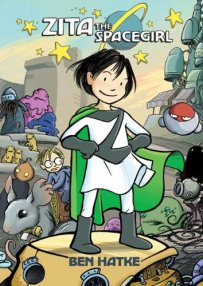
Ben Hatke also creates picture books — I especially like “Julia’s House for Lost Creatures” — but the “Zita” books are popular around here. Zita becomes an accidental interstellar hero when she presses the wrong red button and sends herself and a friend to another planet. One of the things I really like about this series is that Zita always goes out of her way to help others, making them want to help her in return, and that’s what saves the day. Also, I’m fascinated with the artwork; I love art that’s deceptively simple, in which every line is perfect.

“Bone,” Jeff Smith
51BKe2+qjJL.jpg

One of the forerunners of the kids’ comics subgenre, this one starts out lighthearted and gets more serious as the characters go up against increasingly darker forces to save themselves and humanity. If you’re going to read kids’ comics, you should read this one, though you may never again hear the word “quiche” without giggling (and I’m a little worried I’ve soured the kids on “Moby-Dick,” since every time Fone Bone tries to tell any other character about how much he loves it, they fall asleep). There’s social commentary as well, about the abuse of power and allowing yourself to be manipulated by others, among other things, but on a level that kids can understand. I gave the complete series to my son a while back and both kids repeatedly devoured it. What really baffled them was discovering my original “Bone” comics from the ’90s. “Mommy, how do you already have this? Why is it only one issue?”

Finally, in case you need to justify your kids’ (or your) literary choices to anyone, here’s this excellent article on why graphic novels are “real” reading. Enjoy.

Recapping NJSCBWI17

I love this conference. It’s so friendly and informative. I see friends, I walk away with story and revision ideas, I get to admire amazing artwork and I get to buy people’s books. Entirely a win-win.

IMG_2398

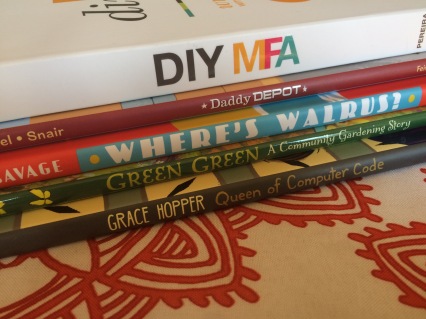
What I bought at the conference. Missing: Robin Newman’s “The Case of the Poached Egg.” My son poached it.

OK, also I love that there are so many great kidlit resources in my own state. That is highly convenient and proof that New Jersey is a superior place to live. Don’t believe the jokes.

Conference workshops included in-depth discussions on creating characters of a different race or ethnicity (short answer: you absolutely can, just do the research and avoid tropes); on using white space and text placement to pace the emotion in a picture book; on solving problems in a story by looking elsewhere in the text for the answer; on being your true (and gracious!) self on social media; on how to build your story’s world without info-dumping; and on why you shouldn’t be afraid to talk to your agent.

I enjoyed Gabriela Pereira’s workshop on middle grade and YA novels so much, I went and bought her “DIY MFA” book conveniently just as she was walking into the book fair area. It’s nice to be able to tell someone, “Hey, I’m buying your book, thanks for your help!”

Really the best part of the conference is being around other creative people, all of whom are trying to accomplish the same thing you’re trying to accomplish, all of whom care deeply about quality children’s literature. People have a way of cheering each other on that I think might not be typical of other corners of the publishing world.

It was also entertaining to share a hotel with — I think — two weddings and two proms in one weekend. (Side note: Prom dresses are so much more sophisticated than when I was in high school. Slightly jealous.) A bridesmaid was overheard asking if she was allowed to have some of our coffee. I hope she went for it — we had plenty!

And now on to rereading my notes and revising manuscripts.

Creativity outside the comfort zone

“Sure, I’ll do an art class with you,” I told my friend. I wasn’t expecting any actual art to come out of it, but hey, why not.

I hadn’t taken a proper art class since college. (Paint and Wine with my husband on Valentine’s Day doesn’t count. Though it was fun.) I was an art minor. There might be some germ of a molecule of art talent in there somewhere, but I knew words were my thing. That was especially obvious when I looked at my classmates’ work; if I was playing cute little melodies, art-wise, they had full orchestras going. So I had no great expectations for my art classes, but I enjoyed them. Then I graduated from college and stopped making art.

A month ago, my friend said she’d always wanted to take an art class but hadn’t done it. I shrugged and signed up with her.

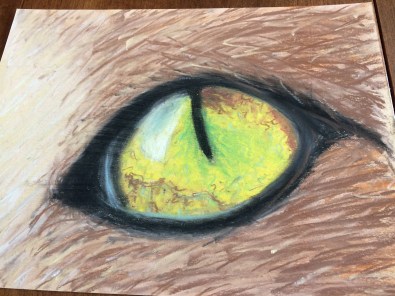
It was a pastels class — a medium I’d used twice, maybe — and the instructor was great about sketching out the way to copy the chosen picture, piece by piece, with suggestions on color and type of line. And with such guidance, I got this: IMG_2372 (1)

Which isn’t bad!

The thing is, I dropped art in the first place because I was a writer, and I thought I should focus on writing. But practicing any form of creativity makes you better at being creative. Making art, or music, or writing in a different form or style might even jog you out of a creative rut, helping you to see something with a fresh eye (hey, see what I did there?).

I still don’t see myself as an artist. But remembering that I could make art, aside from the various works-in-progress in my notebooks, was actually pretty empowering.

My friend and I had a fine time and are already discussing which class to take next. I can’t wait.


Submission Tips for the Rutgers University Council on Children’s Literature Conference

Excellent kidlit writer Tara Lazar offers excellent tips on submitting for the Rutgers University Council on Children’s Literature Conference. I’m submitting, are you?

Tara Lazar's avatarWriting for Kids (While Raising Them)

2016 RUCCL Mentors

.

If you’re submitting to RUCCL One-on-One Plus Conference, please know…

The manuscript’s the thing.

If you send your submission to the wrong address, don’t worry, we’ll get it to the right place.

If you forget to send a check, don’t worry, we’ll get in touch.

If you somehow mess up the instructions, don’t worry. It’s OK. We are not here to impose penalties on you. We want you to get in, we really do! We read each manuscript thoroughly and determine its merits. There are no red marks on your paper or strikes against you. We strive to look for the positive in every submission we receive.

If you get in, rejoice! It means the reading team liked your submission AND we had a mentor to pair you with. Sometimes we have more mentors for YA than picture books, or more for MG than non-fiction…

View original post 420 more words

What we’ve been reading

The kids are wrapping up their spring break, the eggs have been successfully hunted, the matzah has been eaten, and I have to remind myself to stay away from the jellybeans and chocolate. In between “Harry Potter” sessions (we’re on “The Order of the Phoenix” these days), there’s been a few other great reads.

“Ms. Bixby’s Last Day,” John David Anderson: I’d been reading a lot about this book before I picked it up, and wow is it heartbreaking and amazing. Three sixth-gra51TNY92PdiL.jpgders give their favorite teacher the last day she deserves, revealing in the process why she’s so special to each of them. The sensitive topic is deftly handled, and the alternating chapters give each boy his own distinct, funny, sharp voice. This is the sort of book you read if you want to write middle grade. (I love that reading great books is considered research.) Reading it made me think about my own favorite teachers and what they meant to me, which I suspect is how everyone reacts to it. There’s a lot of wisdom in this book, from the boys as well as their teacher.


“Happy Dreamer,” Peter H. Reynolds: The original title of this book was “Amaz71+Vzle8PiL.jpging, Delightful, Happy Dreamer,” as Reynolds wrote in Nerdy Book Club, and the initials were intended to spell ADHD (the whole phrase does appear in the book). Reynolds said he dealt with ADHD symptoms while he was growing up, and wanted to reassure kids with creative, outside-the-box brains that they are special and needed, even if the grownups around them are just telling them to sit up straight, pay attention in class, and clean their rooms.

We deal with ADHD a fair amount in this household, and everything Reynolds describes in the book, from the daydreaminess down to the messy room, is spot on. I love having such a positive, supportive book around, as a reminder that the daydreamy people are entitled to feel valued, and success in life doesn’t necessarily equal sitting still in class. I love all of Reynolds’ books — “The Dot,” “Ish,” “Playing by Heart” — for what they say about the importance of creativity and individuality, but I might love this one the most.


Hurry up and wait

So here is where my day job conflicts with my fiction writing.

My day job currently consists of writing news and features articles, and editing pieces for various companies. I’ve done the newbie-reporter gig of covering municipal meetings and county fairs, and logged a number of years as a newspaper copy editor. The copydesk edits all articles in the paper, writes the headlines, fine-tunes (or fully creates) the page layout and clears everything to go to press. What does all this have in common? It needs to be done right now. Or ten minutes ago, if you can swing it. Deadline waits for no one. Missing deadline and making the paper late invites capital punishment. Think I’m kidding? Here is the original definition of the word “deadline.”

When I started seriously writing fiction and researching the kidlit industry, imagine my surprise to discover right now is not how it works. Agents and editors don’t want you to rush. They want you to put the story down, give it time, then pick it back up with new eyes so you can revise it properly; if you send them a revision too quickly, they’re liable to decide you took too little time on it and reject it. I was at first baffled by this, then slightly tearing-my-hair-out about it. “But don’t you want it to be done? Isn’t it done now? How long should I be taking to make it done? Arrrrrrgggghhhhhhh.”

It’s taken some practice. But I’ve been getting better at allowing time for breathing room, and letting the story be done when it’s ready to be done. So, don’t make my newbie mistake. Put it down. Give it time. Breathe.

(But if you’ve got a firm deadline, please, don’t blow it.)

Don’t let newspapers die

Periodically I tweet #buyanewspaper at people, for whatever that’s worth. (Probably not much.) It’s on my mind these days, because I’ve been watching a lot of my colleagues lose jobs.

Specifically, about 130 of them in November. Another 141 of them this month.

I freelance these days. It suits me. Layoffs at the newspaper where I used to work don’t affect me personally, except for making my heart hurt, because I was there for 10 years. Putting that in perspective, these were the people who saw me through both my pregnancies, commiserated about parenting, confided in me, laughed with me. The people I gleefully analyzed episodes of “24” and “Agents of S.H.I.E.L.D.” with. The people I survived working election night with. (It’s the worst. You have to wait for the polls to close and then you have to scramble to make deadline.) The people I secretly snuck up to the roof of the building with after deadline to watch fireworks on the Fourth of July.

These are good, talented people, and they did not deserve to lose their jobs.

More to the point: These are the people who helped make the newspaper an essential read for the community it covers, and with them gone, there’s less of a reason to read the paper. And that’s not just a loss for my colleagues, it’s a loss for the community.

I’ve long believed that if you want to know more about the town you’re in — what’s it like to live in, what’s important to its residents — you read the local paper, which is why I track down one whenever I travel somewhere. (My parents still bring me back newspapers from wherever they were when they travel.) I can tell a lot about a place even by how thick the paper is, what kind of ads are in it and how well written and edited it is. A newspaper with almost no staff? That says it’s a paper not properly serving its community, because it doesn’t have the resources or the will.

Or it’s a paper no one is buying anymore.

Newspapers need subscribers. They need people to care about the paper on a regular basis, not just when they’re annoyed about something and writing letters to the editor, not just when someone they know got interviewed. All the time, or else the paper slowly disappears.

I don’t know what’s going to happen to what’s left of my old paper. But I hope it survives. I hope they all survive, because they’re needed.