I loved comic books growing up. I still do, largely for the same reason I love picture books: They’re this wonderful combination of words and artwork, and the two intertwine to tell a story in a way that neither could do alone. At first I had to rely on whatever two- or three-packs of X-Men or Batman that my parents brought home from random places; when I was older and had spending money, I discovered comic book stores, and it was glorious.
Funny thing, though. I also discovered that the big-name superhero comics weren’t necessarily the ones I wanted to buy. They were issue 23 in a convoluted, multi-title story arc that I couldn’t follow unless I bought every single issue and cleaned out my wallet. They were a thousand variant covers of the same issue. Or — most notably — the female characters were super-gorgeous and in need of rescue, or super-gorgeous and dead and needing to be avenged. Even a lot of comics about superheroines seemed to focus more on their super-gorgeousness than on anything they actually did. It got to the point where I would look at a comic with a super-busty woman on the cover, drawn in some over-the-top-sexy pose, and think, “I’m not the target audience for this comic.” And move on.
Instead I read “Elfquest,” and later “Sandman,” “Stardust,” “Lucifer,” “Powers,” “Bone,” “Blue Monday,” “Hopeless Savages,” “Optic Nerve,” “Breakfast After Noon,” “Slow News Day,” “Swamp Thing,” “Miracleman,” and a few others you’ve probably never heard of. Some were child-appropriate; most were not (to be fair, I didn’t have kids yet). But they were thoughtful, well written, beautifully drawn, occasionally funny, occasionally heartbreaking, and original.
I lost the comics habit for a few years post-motherhood, rediscovering my love of children’s literature instead. Then I noticed something in my regular haunts of the children’s section at the library: Kids’ comics. Actual all-ages comics. Funny, smart, well written, well drawn, and no over-the-top-sexiness (or horrifyingly jarring violence) in sight. Where were these when I was a kid?
Kids’ comics are where the growth is in the comics medium, according to this article from New York magazine’s Vulture site. To quote: “According to Milton Griepp of comics-industry analysis site ICv2, aggregated annual comics sales across different kinds of retailers for 2016 revealed that more than half of the top-ten comics franchises were ones aimed at kids.” To back that up: I’ve been hanging around a few more comics stores than usual lately, and those owners said that on Free Comic Book Day, the kids’ comics are the ones flying off the shelves.
In fact, according to the ALA’s annual list of most-challenged books, three out of ten on the 2016 list were graphic novels.
And most interestingly to me, per the Vulture article: “One of the most remarkable things about the Youth-Comics Explosion is how much it reaches out to young girls — a population long alienated by mainstream superhero comics. That’s due in no small part to another remarkable thing: A massive portion of the people creating these comics are women, something unheard of in the majority-male space of superhero-comics publishing.”
In other words, I wasn’t the only geek girl who wanted a better selection at the comics store.
So the kids and I are reading comics together and it’s been a lot of fun. I get to rediscover a medium I always loved while introducing it to the kids.
Here are some of the comics we like. Please note: A graphic novel is a book-length comic. A trade is a book-length collection of comics previously published as individual issues. The below list features both. Just to get the persnickety out of the way.
“Ghosts,” Raina Telgemeier

Okay, we have a lot of catching up to do on Raina Telgemeier’s work (“Smile,” “Sisters,” “Drama”), because we’ve only read this one so far. But this one is fantastic. It’s about a girl struggling to deal with her sister’s cystic fibrosis while moving to a new town and rediscovering part of her heritage. It’s also about the Mexican Day of the Dead, which I’ve always found fascinating. It’s funny and moving and will probably make you tear up. Raina’s books are credited for jump-starting the explosion in kids’ comics, and for that I thank her.
“Lumberjanes,” Noelle Stevenson, Grace Ellis, Brooke Allen, etc.

Side conversations with the kids sparked by “Lumberjanes”: Who are Apollo and Artemis in Greek mythology? Who is Nellie Bly? Who is Admiral Malahayati? Can I have a coonskin cap? Can I go to scout camp? (Sure, kids, but there won’t be any yetis. Or selkies. Or werewolves. Or raptors. Or three-eyed foxes.)
The occasionally slapsticky story of five friends spending the summer dealing with mythological creatures at Lumberjanes camp — which was meant to be an eight-issue run but won enough fans to become a monthly comic — always gives us things to talk about. Fun running jokes: Instead of the usual interjections whenever the characters are frustrated or scared, they yell the names of famous women. And the girls of the Roanoke cabin are great at handling roller-derbying Sasquatches or riot grrl mermaid bands, but terrible at normal camp things like pitching tents.
What’s also been helpful is that several of the characters are LGBT, and I’ve been able to use them as teaching tools as the kids encounter LGBT people in real life. I appreciate having that opportunity.
We’ve gotten caught up on the back issues and now the kids are asking, “Where’s issue 39? Where’s issue 40?” and I tell them, “Yeah, now you have to wait a month.” Welcome to comics, kids!
“Zita the Spacegirl,” Ben Hatke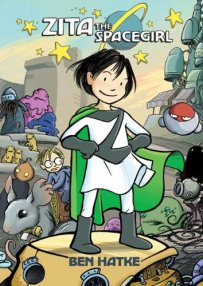
Ben Hatke also creates picture books — I especially like “Julia’s House for Lost Creatures” — but the “Zita” books are popular around here. Zita becomes an accidental interstellar hero when she presses the wrong red button and sends herself and a friend to another planet. One of the things I really like about this series is that Zita always goes out of her way to help others, making them want to help her in return, and that’s what saves the day. Also, I’m fascinated with the artwork; I love art that’s deceptively simple, in which every line is perfect.
“Bone,” Jeff Smith

One of the forerunners of the kids’ comics subgenre, this one starts out lighthearted and gets more serious as the characters go up against increasingly darker forces to save themselves and humanity. If you’re going to read kids’ comics, you should read this one, though you may never again hear the word “quiche” without giggling (and I’m a little worried I’ve soured the kids on “Moby-Dick,” since every time Fone Bone tries to tell any other character about how much he loves it, they fall asleep). There’s social commentary as well, about the abuse of power and allowing yourself to be manipulated by others, among other things, but on a level that kids can understand. I gave the complete series to my son a while back and both kids repeatedly devoured it. What really baffled them was discovering my original “Bone” comics from the ’90s. “Mommy, how do you already have this? Why is it only one issue?”
Finally, in case you need to justify your kids’ (or your) literary choices to anyone, here’s this excellent article on why graphic novels are “real” reading. Enjoy.



 2016 RUCCL Mentors
  ders give their favorite teacher the last day she deserves, revealing in the process why she’s so special to each of them. The sensitive topic is deftly handled, and the alternating chapters give each boy his own distinct, funny, sharp voice. This is the sort of book you read if you want to write middle grade. (I love that reading great books is considered research.) Reading it made me think about my own favorite teachers and what they meant to me, which I suspect is how everyone reacts to it. There’s a lot of wisdom in this book, from the boys as well as their teacher.
 ing, Delightful, Happy Dreamer,” as Reynolds wrote in
