“Sure, I’ll do an art class with you,” I told my friend. I wasn’t expecting any actual art to come out of it, but hey, why not.
I hadn’t taken a proper art class since college. (Paint and Wine with my husband on Valentine’s Day doesn’t count. Though it was fun.) I was an art minor. There might be some germ of a molecule of art talent in there somewhere, but I knew words were my thing. That was especially obvious when I looked at my classmates’ work; if I was playing cute little melodies, art-wise, they had full orchestras going. So I had no great expectations for my art classes, but I enjoyed them. Then I graduated from college and stopped making art.
A month ago, my friend said she’d always wanted to take an art class but hadn’t done it. I shrugged and signed up with her.
It was a pastels class — a medium I’d used twice, maybe — and the instructor was great about sketching out the way to copy the chosen picture, piece by piece, with suggestions on color and type of line. And with such guidance, I got this: 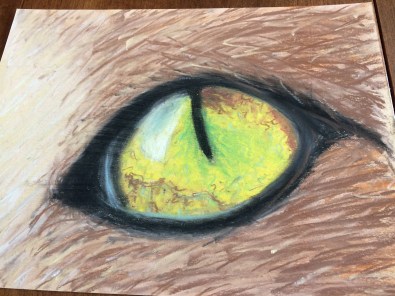
Which isn’t bad!
The thing is, I dropped art in the first place because I was a writer, and I thought I should focus on writing. But practicing any form of creativity makes you better at being creative. Making art, or music, or writing in a different form or style might even jog you out of a creative rut, helping you to see something with a fresh eye (hey, see what I did there?).
I still don’t see myself as an artist. But remembering that I could make art, aside from the various works-in-progress in my notebooks, was actually pretty empowering.
My friend and I had a fine time and are already discussing which class to take next. I can’t wait.
 Marlaina Cockcroft