News and updates

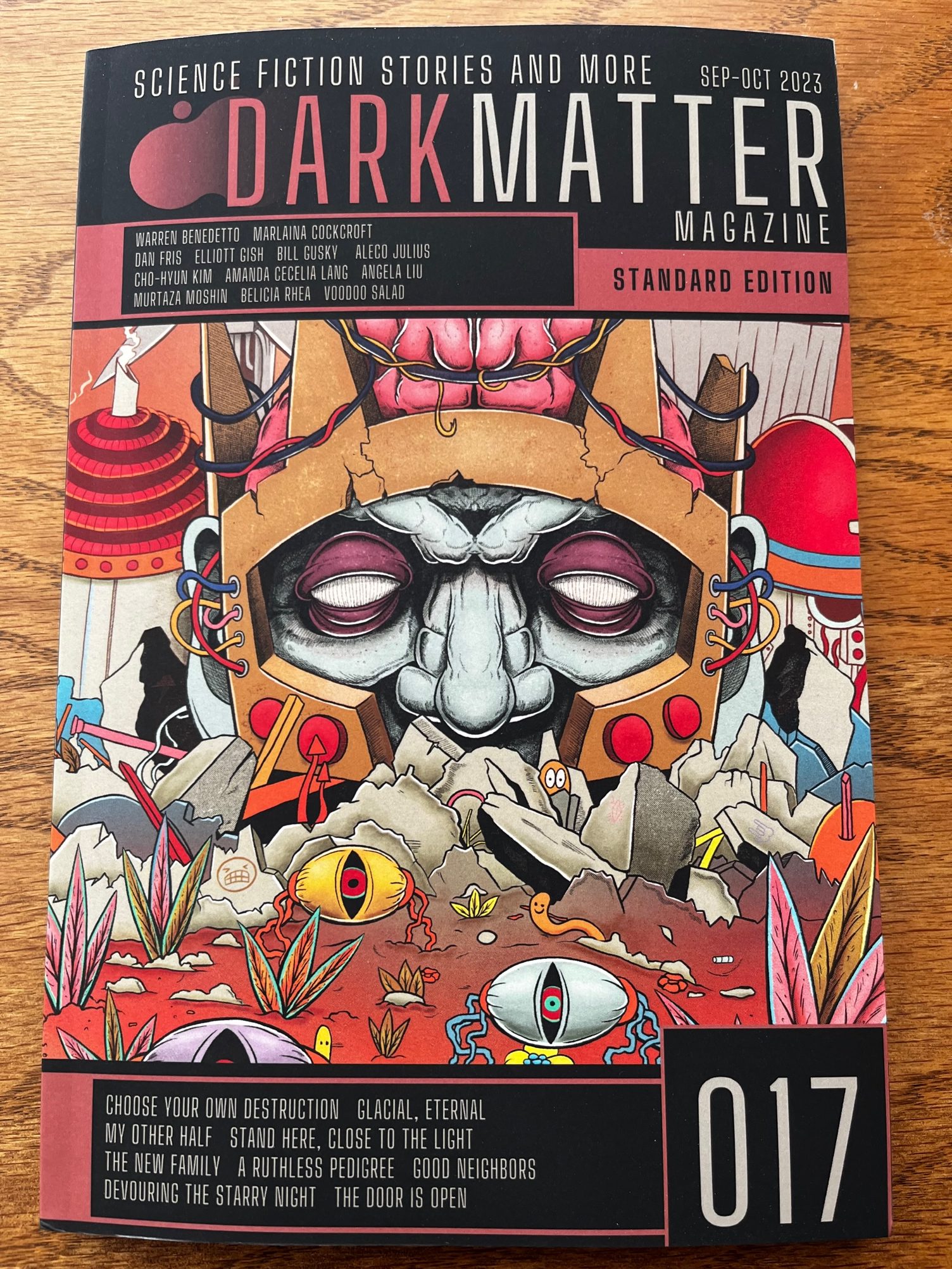
I’ve had the pleasure of being published twice this month, both horror stories. My creepy gardening story “Good Neighbors” is in issue 17 of Dark Matter Magazine, which is unfortunately one of the final issues of the magazine because Dark Matter Media is pivoting to do more anthologies and other projects. They’re lovely to work with *and* they send thank-you notes to contributors, so I’m hoping I’ll get a chance to work with them again.

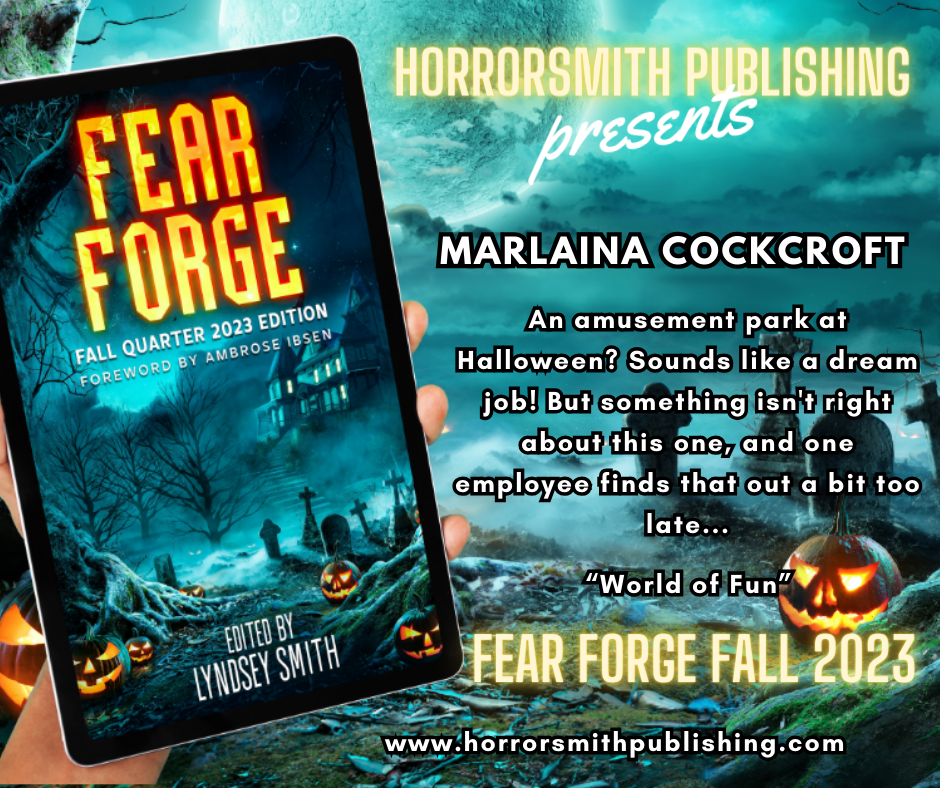
My dead-kids-in-an-amusement-park story, “World of Fun,” appears in the fall 2023 edition of Fear Forge Anthology. I’m pretty happy about this one because I’ve been trying to get this story published for a while, and I’m so glad people can read it now. Obviously any resemblance to real-life amusement park incidents, say in the 1980s, is entirely coincidental. The editor is a sweetheart and as you can see, produces some pretty nice promo images for her authors.

Why read horror when there’s so much real-life horror out there? Because any fiction is escapism of a sort. Because grim times call for grim entertainment. But mainly because horror stories can offer a weird sort of hope; there may be monsters in the world, but the monsters can be beaten. And maybe the misunderstood monsters can find a place in the world after all.

This is the quote I’m thinking of, and if you’re also a Neil Gaiman fan you’re not surprised. It’s from G.K. Chesterton, and it’s the epigraph to Coraline:

Fairy tales are more than true: not because they tell us that dragons exist, but because they tell us that dragons can be beaten.

***

And now back to real-life horror.

I’m adding a few more groups to this list of organizations helping civilians in Israel and in Gaza. I don’t know the status of Gaza right now, or when aid will be able to get through again, but I’ll keep listing those groups in the meantime because they’ll need the resources when they can get back in.

Stay well, stay safe.

National Council of Jewish Women is a women- and family-centered social justice group that’s raising funds to provide basic needs, counseling, and advocacy for women and families impacted by the Hamas attack

Women Wage Peace is a women-led, nonpartisan grassroots group that advocates for a diplomatic solution to the Israeli-Palestinian conflict

World Central Kitchen is feeding displaced families in Israel and working with a local partner in Gaza to distribute meals to Palestinians

Soroka Medical Center is handling the emergency medical response in Israel

The JDC helps Jews and others in crisis around the world

Save the Children is trying to get needed supplies into Gaza

American Friends of Magen David Adom is Israel’s first aid/first responder service

United Hatzalah is a volunteer emergency medical services organization that operates across Israel

Americares is trying to assist with people’s medical needs in Gaza

Doctors Without Borders is trying to assist with people’s medical needs in Gaza

The International Committee of the Red Cross is providing medical supplies and household items to people in Gaza and trying to help people in Israel locate missing family members

The Forward has a longer list of organizations that need help. And CNN has set up a fund that allows you to donate to multiple organizations at once, including several listed above.
The state of school libraries

My latest article for School Library Journal is about book challenges in school libraries across the nation. No, it’s not pleasant. Yes, it’s worth reading. And so are the books being challenged.

Librarians are the keepers of information in our society, and they shouldn’t be harassed and targeted for doing their jobs.

If you’d like to learn more, you can download SLJ’s full Controversial Books Survey. If you want regular updates about book challenges and advice on what to do about them, check SLJ’s coverage or Kelly Jensen’s weekly roundup in Book Riot.

My personal advice? Show up at your town’s school board meetings. You might not have a local newspaper anymore, and you should stay informed about what your school board is doing—and you shouldn’t let them or librarians be bullied into taking actions that would hurt people.

Good luck, and happy Friday.

My Q&A with Super Copy Editors

Super Copy Editors is where I do a fair amount of my freelance work—it’s a great company, and founder Dave Baker is a pleasure to work with. He interviews one team member every month for the company newsletter, and I enjoyed the interview so much I requested to share it. So here it is, for your reading pleasure. Have a lovely week.

In person, again

I thought I’d remembered everything about in-person writers’ conferences. Bring a scarf or wrap. Wear comfortable shoes. Bring a notepad and pen for when you get good advice or when inspiration strikes. Caffeinate regularly. But nope, I forgot that the air conditioning would also be intense enough to affect my feet. I spent half the day thinking sandals, ugh, where are my sneakers? Listen, it’s been a few years.

I’ve spent most of this year feeling like we were finally easing back into something more or less resembling regular life. We restarted our annual Super Bowl party. I started leaving the house without a mask in my bag. We hung around older family members without worrying about anyone’s exposure levels. And NJ SCBWI held an in-person conference again.

I’m glad there are more virtual options out there now for conferences, workshops, and webinars. They’re a lifeline for people who can’t travel, who need disability accommodations, or who are immunocompromised. But I never feel fully connected to people through a screen. I’m the sort of introvert who works best in one-on-one interactions, where I can see the other person’s face and hear their voice. Without that, I feel like I’m missing vital information. With that—well, every writer friend I have is someone I met at a conference or other event. One of those friends led me to my critique group. I’ve gotten editing work through writer friends, I’ve gotten feedback that helped me improve my own work, and I hope I’ve helped other people improve theirs. More intangibly, I’ve developed a sense of belonging. When I walked into the conference building, I saw people I knew, people I hadn’t seen in person in years. It felt like a homecoming. And that alone was worth the price of admission.

So thanks to NJ SCBWI for putting the event together (standouts for me: Andrea Loney’s “Creator Care” presentation and Yvonne Ventresca’s workshop on revision tools and techniques), and thanks to Montclair University for hosting. I was really grateful to be around my fellow creatives again. Even with cold feet.

(But please keep the coffee coming next time! I really do caffeinate continuously.)

All the new things

I hate to be one of those people who starts off a post with “This is why I haven’t been blogging lately,” but … this is why I haven’t been blogging lately: I recently switched from freelance back to full-time. I’m editing for a company that supplies web content to software development companies. It’s been a really nice adjustment, but it has been an adjustment.

In the meantime, my fiction is now featured in three anthologies! The current release, “Clearing the Field,” is in “Stories We Tell After Midnight Volume 3.” It’s about a young Jewish ballplayer who finds a way to fight back against the spectral Nazis haunting her baseball field—which was previously the site of an American Nazi camp. The anthology was released just in time for Halloween, but hey, horror is year-round.

Also out is “In His Name” in “Strange Fire: Jewish Voices from the Pandemic,” about a young woman’s attempt to outwit the Angel of Death and save her dying father, only to discover that you can save someone and lose them at the same time.

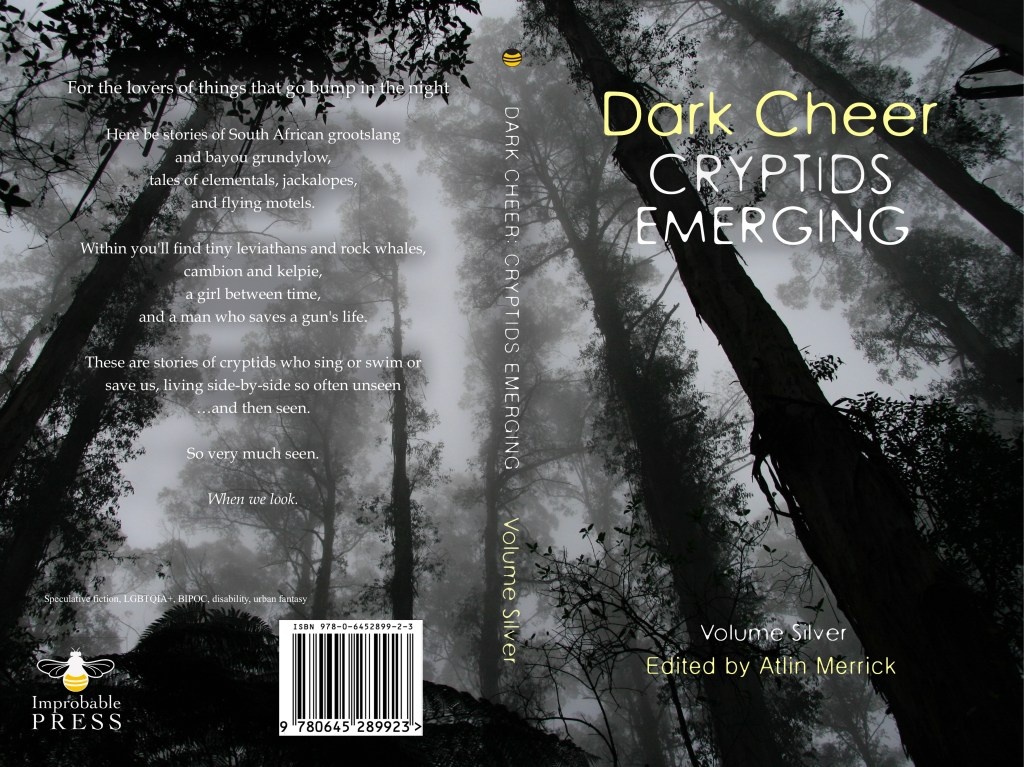
And preorders are up for “Dark Cheer: Cryptids Emerging”: Volume Blue is out in December, and my volume (Silver) is out in February. “Leviathan” is a modern-day retelling of the Biblical legend of the Leviathan—the king of the seas—mixed with a dash of “The Fisherman’s Wife.”

I also recently had the pleasure of attending the Rutgers University Council on Children’s Literature One-on-One Conference, which is application-only and competition is fierce. I got some great feedback on my MG girl-and-golem-fight-antisemitism novel, so I’m hopeful for the next round of queries.

(I will also be so much happier when events like this can be in person again. I miss my writer friends! I hate how I look on Zoom! The cat tries to break into my office!)

Everyone in this house is now vaccinated, and I hope you are too. Hoping you have a close-to-normal Thanksgiving, and if you also celebrate Hanukkah, hoping you squeeze in enough shopping time because argh, it’s early this year.

Submitting to anthologies

Here’s how I see anthology calls for submissions: They’re cool writing prompts that could lead to publication. Sometimes this works out, sometimes it doesn’t. The story I submitted to “Strange Fire: Jewish Voices from the Pandemic” got accepted (and the anthology is out this month!). Stories I’ve written for consideration in other anthologies have gotten rejected, and I’ve been researching magazines/other publications to send them (some sources I like: The Submission Grinder, Erica Verrillo’s Publishing … and Other Forms of Insanity blog).

But sometimes the stars align and an already-written story fits what an anthology editor wants. For instance, my story that just got accepted for “Dark Cheer: Cryptids Emerging,” out in 2022 (preorder link to come when it’s available). So you never know. But I’m pretty happy about both of these acceptances.

The same goes for contest submissions. I didn’t advance in this year’s NYC Midnight Short Story Challenge, but I did end up with a fun sci-fi rom-com story that I hope to find a home for.

If you’re willing to accept the risk of your story getting rejected—which is kind of a requirement for being a writer—then writing for anthologies or contests can be a good part of an overall submission strategy. Good luck and have a creative week.

Little wins and big wins

I did the final proofread on a short story of mine that’s being published in an anthology. I lost a regular writing/editing gig, since the one remaining newspaper I freelanced for is shutting down. I sent out new queries to magazines on short stories and to agents on my novel, and got some encouraging rejection letters. It’s been an up-and-down couple of weeks.

But that’s the creative life, whether you’re writing for pay or writing for the love of it (ideally both?). Up, down, forward, back. Be happy at the good news, roll your eyes at the bad news, keep going.

Any success this past year is worth celebrating. Any ability to achieve anything close to normal is worth celebrating. Listen, I just got my first haircut in a year and a half. The little wins are big right now.

So I hope you’re achieving little and big wins, and you’re being as creative as you’re able to under the circumstances. And I hope you’re able to get vaccinated (I’m Team J&J, how about you?) so we can get past this thing once and for all. It’s getting warmer out, and I’d like to be someplace besides my back yard.

Congratulations on whatever wins you achieve this spring.

Common rules of editing

As part of my day job, I edit everything from novel manuscripts to news stories to healthcare content to nonprofit papers. Yes, I do like the variety. But there are some common rules that I rely on, no matter what type of work I’m editing. Here are a few:

  1. It’s not my byline. My name won’t be appearing on top of the article, on the cover page of the book, etc. This isn’t my work, I don’t own it. Ultimately, my job is to best serve the writer. My ego has no place in the process.
  2. Use the writer’s voice. Everyone, if they’ve been writing long enough, has a “stable” of words and phrases they use regularly. They tend to use commas in a certain way, or love to throw in the occasional em dash. Their sentences are long and flowing, short and powerful, or somewhere in between. If I tweak or rewrite something, I make sure to use words the writer would use, or structure the sentence the way they would. I keep it in the writer’s voice.
  3. Add compliments. Creative people are a neurotic, insecure bunch and everyone has imposter syndrome. (Including me.) The tendency when editing is to focus only on what needs fixing, but that can come off as too negative. If a joke works, a line of description is especially lyrical, or there’s really good information shared in a clear way, I make sure to note that. People deserve to feel good about their work.
  4. Stay open to suggestions. The writer’s suggested rewrite might be better than mine. And that’s fine by me.
  5. Be prepared to explain myself. At various publications, I’ve worked with writers who shrugged at whatever changes I wanted to make, saying “I trust you.” I’ve also worked with writers who challenged everything I marked on their articles. Sometimes my explanation satisfied them; sometimes they asked for a different change instead. But if I couldn’t justify the changes I wanted to make, did I have any right to make them? The writers were trying to have some say in the final version of their work. (See rule #1.)
  6. Look everything up. I work with the Associated Press Stylebook, the Chicago Manual of Style, and whatever individual house styles different publications use. That’s a lot of different style guides, some of which contradict each other. (Do I use serial commas this time? Are there spaces around the em dashes or not?) It’s not possible to keep all of that in my head, so I don’t try. Editors and copy editors are more likely to get into trouble when they think, “I know this,” and don’t check to make sure they’re right.
  7. I don’t represent all readers everywhere. I might not be the target market for the work. That doesn’t mean the work should be written to appeal to me personally. That means I need to keep in mind who the target readers are, and edit accordingly. And if that means I need to look up something I don’t know, well, looking things up is my job.

It all comes down to the Golden Rule of editing: Treat the writer the way you would want to be treated as a writer. And that rule has worked well for me.

What we’ve accomplished

President-elect Joe Biden has won the election for approximately the 473897328763287643th time, front-line workers are starting to get vaccinated, snowpocalypse is coming tomorrow. Already it’s quite the week.

For Hanukkah, we did a chilly outdoor get-together with my parents, chatting behind masks until the wind was too much. For Christmas, we’re doing nothing. My in-laws live too far away, outdoors isn’t an option, staying there isn’t safe. It would’ve been nice for the kids to see their grandmother since they lost their grandfather to cancer in April, but that would’ve required more people (not to mention our leaders) to follow virus restrictions this year, wear masks, care about other people instead of blah blah blah freedom, so here we are.

If I sound angry and frustrated, that’s because I am. Those “we’re all in this together” ads have never been true, not once.

Still, those of us who are still here have managed to survive the pandemic and the horrific political climate of the past few years, and that’s an accomplishment.

If you’ve managed to create anything during this year, that’s an accomplishment, too.

In between rounds of edits on my middle grade manuscript, I started writing short stories again. One was published in Daily Science Fiction. Another will be published in an anthology called “Strange Fire: Jewish Voices from the Pandemic,” out next year. A third is waiting in a submission queue (argh).

I haven’t found an agent yet for my kidlit work, but I’m ending the year with two middle grade manuscripts that are stronger than they were in January.

I worked with some wonderful author clients this year on their manuscripts, including one for the second time. My coaching client got another article posted. And I picked up some new freelance writing work.

What about you? Did you create something? Did you make a sourdough loaf? Did you keep your household going despite all odds? All successes. We’re still in the tunnel, but there’s a light at the end of it.

So whatever you celebrate, have a happy, safe, quiet holiday. If you need an editor in the coming year, please do reach out. And go easy on yourself. You’re surviving a pandemic. You’re doing fine.

Do what you can

This morning, the kids had online orientation sessions with their teachers for the start of virtual school next week. I confirmed to the board of ed that my son would rather continue occupational therapy virtually than do it in-person at the school. And I’ll be taking him “school shopping” for clothes that his classmates will only see part of, onscreen.

And the weirdness continues.

There are no good solutions here, and there are no winners. In-person classes raise the risk of the virus. Remote classes don’t let kids socialize. Parents aren’t qualified teachers. Teachers and school staff shouldn’t have to risk their lives (or their families’ lives) for their jobs. Parents shouldn’t have to choose between their kids or their jobs. Families shouldn’t have to worry about loss of income because they don’t have child care. None of this is right.

But normal isn’t an option. We don’t get normal until we beat the virus.

If you walk around silently seething at the world under your mask, trust me, you’re not alone.

So we do what we can. We make school work, in whatever version of it we have. We get our work done, by whatever means necessary. We order out to support local restaurants and go shopping to support small businesses and we take walks on nature trails because we’re still not comfortable with fitness classes. And we write at midnight because that’s when the house is quiet.

(Okay, all of that was me.)

How do you stay creative during an endless crisis, or rolling series of overlapping crises? Cut yourself lots of breaks. You’re tired, take a nap. Your mind’s shut down, have ice cream and watch “Galaxy Quest.” Stuck on writing one thing? Write something else for a while.

I’ve spent a lot of this year revising my middle grade novel, to the point where I wasn’t ready to work on another novel. So in between rounds of revision, I started writing short stories again. They came out much better than I thought, and switching around loosened up my brain so that I was better able to focus on revising the novel. I like feeling productive, and that’s what keeps me going.

So much is wrong with this moment in our history. The way we get through it is by acknowledging that nothing is normal—shouting it from the rooftops if necessary—and by taking care of ourselves and each other.

Happy holiday weekend. Wear a mask, stand up for what’s right, keep writing. And however you’re voting this year, GET IT DONE.