Invasive punctuation

I have nothing against semicolons. Or em dashes. Or parentheses or exclamation points or colons. And yet when editing, I remove them. I boot them right out of the story.

Not all of them, of course. But the thing is, it’s easy to overuse punctuation marks. Semicolons and em dashes stand out precisely because they aren’t meant to show up in every sentence. Too many of them at once and they clutter up the page, distracting the reader. (And parentheticals are supposed to convey information that’s additional to the main point that the writer is trying to convey, so it’s awkward to introduce something in parentheses and then use it in the main body of the text as though it were there all along. Yes, I’m being meta.)

Any punctuation that gets overused begins to have the same effect as someone typing in all-caps all the time; it hurts the reader’s eyes and they stop reading. For a particular punctuation mark to have an effect, it needs to be used sparingly.

So think of it as weeding a garden. Leave the good marks in place and yank out the unnecessary, incorrect, or annoying ones. The result is cleaner, more graceful, and easier to read. Your reader will thank you.

Let them read comics

A family member was waiting out the storm with us last week (two snow days, ugh) and noticed how voraciously the kids were reading comics. Before he left, the family member said to them, “Make sure you read books sometimes and not just comics.”

I said, “They can read what they want at home. Also, their grades are good and they both score well on standardized tests, so I’m not too worried.”

He conceded, “I used to read comics when I was their age.”

“I read comics now,” I said. Which ended the conversation.

Listen, I’m all in favor of book-nerdery. But I don’t like snobbery. Reading comics and graphic novels is still reading. It absolutely counts. And the kids and I have read so many good comics over the past couple of years—smart writing, beautiful illustrations, full of heart—that I can’t see why anyone would say that reading them is somehow less valuable than reading a text-only book. (Last graphic novel to make me tear up: “Ghosts” by Raina Telgemeier. Last comics to make me laugh out loud: “Ms. Marvel” and “The Unbeatable Squirrel Girl.” On repeated occasions.)

In fact, I might argue that teaching kids to appreciate good artwork is just as important as teaching them to appreciate good writing, and conveniently, picture books and comics have both.

When I was a kid, I read whatever I wanted, mostly because it would have been impossible for my parents to stop me. Shakespeare. World mythology. My dad’s science fiction and fantasy novels. And yes, comics. None of it hurt me. In fact, given I was a gifted student, on the honor roll, and graduated college on the Dean’s List, I’d say all of it helped me. (True story: I once used an issue of “Sandman” for a paper in my Greek mythology class. So helpful, that Neil Gaiman.)

So my kids can read what they want, too. I think it’s all to the good.

Bringing the news offline

I’d share some of the articles I’ve been writing lately, but I can’t.

Or more precisely, won’t.

Here’s the deal. One of my regular gigs is writing and editing (and setting up photos and working with reporters and helping keep things moving) at this local newspaper. You’ll note there are no articles posted on the website. There never are. The paper is print-only. And I’m glad.

Back in the ’90s, when newspapers decided they needed websites, the orders came down to put all articles on the website. For free. And I thought, “But why would anyone buy the paper if they can read the whole thing for free online?” Alas, I was a lowly copy editor and who cared what I thought.

So we put everything online. For free. Even though newspaper circulation had already been slipping downward for a while, and Generations X (that’s me), Y, Z, Z-plus and whatever else they’re going with these days didn’t have the daily newspaper habit their parents and grandparents did. Even though Craigslist and eBay came along to corner the market on classifieds. Even though advertising started to slip and the cost of newsprint went up. (This article in The Atlantic is a good summation.)

So newspapers lost money, and fired staffers to save money, and lost more money, and got thinner and thinner, with less and less news in them.

The past couple years have been good for the bigger papers, bringing a surge in digital subscriptions. But as the Pew Research Center points out, the industry overall is still suffering.

Now, I’m a book-nerd. Most of my goals for the future involve writing books and working with authors on their books. But I also love newspapers, and have ever since I joined (and later ran) my college newspaper. Newspapers, with a few exceptions, are still the best place to find good journalism. But I’ve been watching colleagues lose their jobs for some time now, and I’ve grown increasingly worried that good journalism is going to disappear with them.

So I was delighted when a colleague of mine announced he was launching his own local paper and looking for freelancers.

Every time I interview someone for an article, about the town food pantry’s plans for outreach or the changes to this year’s arts festival or the expansion of the Middlesex Greenway, they tell me how great the paper is and how glad they are to have a local paper. At the end of one recent interview—which happened to be at a church—the monsignor even blessed me, which was a first. I will definitely take my blessings where I can get them.

And none of these articles is online, because my colleague wants people to buy the paper. Not read it for free.

And frankly, I do too. I want this paper to keep going, because I think this level of local news is what’s missing from most papers now—they don’t have the staff, they don’t have the money, they don’t have the time, etc. I think this is how newspapers survive and thrive: By staying local, and by consistently charging for content. Because I don’t work for free, and neither should anyone else who writes, edits, takes photos, or does graphic design for a living.

So if you want to see what I’ve been working on lately, I’m afraid you’ll have to buy the paper. But trust me: It’s worth it.

Typos matter

I cringe at “speciality.” I groan at “reigning them in.” And when I see “traveling though the town,” I want to throw things.

I see errors like this constantly: in newspapers, in published books, on restaurant menus, on product packages, in the tickers across the screen on news channels, even on storefront signs. I can’t switch off my editor’s eye, so I get regular reminders that people don’t write or type as well as they think they do. (Or that they need to hire an editor.)

Does it matter? Of course it matters. For one thing, people might judge you by your typos. Check out this study by University of Michigan researchers that found people reacted more negatively to emails with errors in them. A good part of my job consists of emailing people about being interviewed for an article or setting up a photo for that article, or else emailing writers about possible editing work. These people don’t know me; all they have to go on is my email, and if that email contains misspellings or poor grammar, they have less reason to take me seriously.

For another, errors and unclear language can cause unnecessary confusion and even cost money. Just ask the dairy drivers in Maine who won a labor dispute case over the lack of an Oxford comma.

You can absolutely be a good writer and still commit typos, or be a terrible writer who spells and punctuates everything correctly. (I’ve dealt with both.) But if the entire point of writing is to communicate with other people, shouldn’t you want to do that as clearly and as accurately as possible—for your readers’ sake, as well as yours?

If nothing else, you’ll have my undying gratitude.

Vacation and idea generation

The family went on vacation last week to … let’s say it was warmer there, with lots of mouse ears? It was a fine time. But January is also StoryStorm, the annual story idea marathon hosted by Tara Lazar that features inspirational posts plus a few prizes (see here for details), which I’ve been participating in for several years. No worries, I thought. I’ll bring my notebook with me, along with my manuscript-in-progress. I’ll get work done on the plane. I’ll think creative thoughts while waiting on line for rides. It’ll be a productive, fabulous time.

Except not.

Turns out I’d underestimated the buildup of mental noise after a day full of lines/rides/crowds/shopping/keeping wandering kids from disappearing/shows/way too much food. At the end of the day, the only thing I was capable of was zoning out at the hotel while watching “Star vs. the Forces of Evil.”

I had no story ideas. My brain was blank for a week.

I’d forgotten the most essential element of creativity: the quiet calm space to escape into your own head for a while. If you’re running around, your mind can’t wander.

On the other hand, sometimes a break from creativity is what you need to recharge. Now that we’re back, I’m steadily catching up and about to cross the finish line.

And I did get some work done on my manuscript. So that’s a win!

STORYSTORM 2018 Registration is OPEN!

I’ve been participating in PiBoIdMo/Storystorm for several years and highly recommend it!

Tara Lazar's avatarWriting for Kids (While Raising Them)

What a glorious feeling!

It’s that time of the year again, when you will be showered with inspiration!

Story ideas are gonna rain down like cats and dogs! (And maybe some will be about cats and dogs!)

Last year I changed the name and month of my annual writing challenge, from Picture Book Idea Month (PiBoIdMo) to Storystorm. Why? Answer’s here.

Any writer interested in brainstorming new story ideas in January is invited to join. Any genre, any style; student, amateur, hobbyist, aspiring author or professional.

How does STORYSTORM work? It’s simple…

  • Register here by signing your name ONCE in the comments below. Teachers participating with a class can register under the teacher’s name.
  • Registering makes you eligible for prizes.
  • Visit this blog daily (right here at taralazar.com) in January for inspirational essays by guest bloggers—professional authors, illustrators and experts in creativity.

  • Instead of visiting the blog directly, you can…

View original post 252 more words

Why I freelance

At the end of October, I had eye surgery. I was supposed to be resting afterward.

I did, sort of, until I got a developmental editing project, a bunch of articles to write and edit, a few rush-job editing projects, a health care communications project …

And in the middle of all that, I finished a rough draft of my novel-in-progress.

So, November was busy. My eye hasn’t exploded, fortunately.

I’d always rather be busy than unbusy, so I’m not complaining (but don’t tell my ophthalmologist what I was up to). Theoretically things have slowed down for the moment, but sometimes the freelance life means not knowing what your day is going to look like until you switch on the computer that morning.

Turns out I like that freeform sort of flow, since I can also, say, duck out to volunteer at my daughter’s holiday boutique (she demanded I look the other way while she was shopping for me) or take my son to Cub Scouts, while still meeting deadlines. Or run over to the farm during CSA season to pick up our share of produce. Or meet a friend for lunch and a write-in. None of that was possible when I was stuck in an office for eight-plus hours a day, then stuck in traffic for another hour-plus, so I do appreciate the freedom. (Especially considering how many hours I also spent last month sitting at the eye doctor’s office.)

It’s not the life for everyone—you have no co-workers to gossip with/about, and if you’re having computer problems you can’t exactly call the IT department—but I concentrate better when it’s quiet. This sounds like a paradox, considering I spent 20 years in noisy newsrooms, but I got pretty good at tuning out the phone chatter, TVs perpetually blaring news updates, and other assorted white noise; now, I don’t have to. I can just focus.

So I’m not sure yet what December is going to be like, but it’ll be fun to find out.

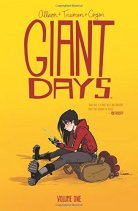
What I’m reading: I’ve gotten slightly obsessed with “Giant Days,” the off-the-wall, goofball story of three friends and roommates trying to survive both college and romance troubles, which is both hilarious and beautifully illustrated. (Side note: Apparently I’m going to read every comic book Boom! Box publishes because that’s how it is.)
41PzrZIw8iL.jpg

I don’t let the kids read this one, because there’s a fair amount of sex- and drug-related humor—the characters are in college, remember—and even though the dialogue does an amazing job of hinting at what everyone is talking about without ever being graphic or explicit, I’d rather wait until the kids are closer to YA-level age. Still, so few TV shows, movies or books really get at the sort of confusion, questioning, and small steps toward adulthood that happen in college; this comic comes pretty close. And bonus, it’s set in England, so you get to imagine all the dialogue with British accents.

And I just finished “Posted” by John David Anderson, which unsurprisingly is amazing, because “Ms. Bixby’s Last Day” was also amazing and made me cry. Anderson is great at detailed, lyrical storytelling that somehow still sounds like it’s coming from a tweenage boy.

51W2QGh17bL.jpg

It’s about what happens at one middle school after phones are banned and kids grab sticky notes to send messages to each other instead, and how even that low-tech system spins wildly out of control when kids start to use the notes for attacks and insults. It’s also about how a change in social status can wreck a solid-seeming friendship. Plus plenty of Dungeons & Dragons jokes for this former D&D player. My one note, and it’s a minor note, is that when Frost, the main character, describes himself as “part of the chorus” in the beginning, it’s a little too accurate; he’s a thoughtful observer of everything happening around him, but he isn’t exactly driving the action until close to the end, and the main drama centers around two other characters. Still, the book is well worth reading, especially for kids who’ve had their own experiences with bullying, online, offline, or through mean little notes.

Editors for Hire

Writers’ Rumpus is always worth reading, and this post is a great summation of how and why to hire an editor.

Joyce Audy Zarins's avatarWRITERS' RUMPUS

Editorial cat

You’ve revised and polished your manuscript, which your critique group has been helping you tweak, and perhaps you’ve even received feedback from a beta reader. You could now run it through the publishing gauntlet, or in view of the stiff competition in the industry, you could take one more step in refining your story. You might consider hiring a freelance editor to give your manuscript a review by one set of professional eyes.

One difference between an editor at a publishing house and a free lance editor is position. When your manuscript is chosen for publication, the in-house editor has thoughtfully selected it from among the many in his/her pile, therefore that editor already loves the concept and is invested in what you have written. In the case of a freelance editor, the editor doesn’t have to like the manuscript in order to work on it and it may not…

View original post 711 more words

Talking to writers

For the first time, I set up shop at a writers conference as an editor-for-hire, claiming a table at the recent New Jersey Romance Writers’ Trade Expo. And it was fun.

I wasn’t able to attend the actual conference (next year!) but looking over the schedule, I was struck by how similar the workshops were to what I’d seen at other conferences: focusing on plot and characterization, marketing your work, learning the ins and outs of the publishing industry. And the other conferences I’ve attended have been either general/all genres, or kidlit-specific.

I opted for candy over swag, per the suggestion of Jennifer Lawler, whose developmental editing classes I’ve been taking through the Editorial Freelancers Association (I highly recommend her classes, and she’s fun to follow on Twitter, too: @JenniferLawler). But I decided to have some fun with it and set out three bowls: regular candy, nut-free candy, and sugar-free candy, with the sign “An editor checks the details.” It got a couple of laughs, which was what I wanted. (For the record, no one took the sugar-free candy.) I had leftovers, but conveniently it’s Halloween, and we get a crowd of trick-or-treaters.

I did worry that I would be sitting there the whole time staring nervously into space, but a steady stream of people stopped to say hello and take my info. And it struck me all over again how universal the conference experience is for writers. I asked everyone how the conference had gone for them, and I got the expected range of answers. One attendee pitched a few manuscripts and had gotten five requests, which is amazing. Another was at her first conference ever and had developed a bit of a deer-in-headlights look; I told her to go relax and take in everything she’d learned. I loved hearing about everyone’s successes, what they were working on, what they were doing next.

The whole experience was a useful reminder that we’re all learning the same things, no matter what we write, and no one is going to understand the process better than another writer.

It was a nice time, and I do appreciate the NJRW for having me. I hope the attendees have success stories to share next year, and I hope to be there to hear them.

How to help

Between the multiple hurricanes and the Las Vegas shooting, it’s been a horrific few weeks. It’s hard to know how to absorb so much tragedy and loss of life. I constantly admire how quickly people step up to help—it’s the bright spot, always, and makes me feel hopeful when there doesn’t seem to be much hope around. So in that spirit, I thought I’d share a few links.

As people in a few of these articles say, giving cash is better than giving things. Cash doesn’t need to be transported, housed, or refrigerated, and it frees up these organizations to use the donation however it’s needed most.

Also, there are inevitable scam organizations that crop up after these sorts of events. Charity Navigator is one way to check whether a charity is legit or to see how much money it spends on staffing and overhead vs. how much it actually spends on the people it’s helping. (Side note: Charity Navigator is itself a charity and accepts donations as well.)

I’ve previously given to the Red Cross (which, incidentally, said as of yesterday that it had enough blood supply to help in Vegas, but if you’d like to help keep them stocked, here’s how to find a blood drive in your area), Austin Pets Alive, and various food banks, but there are a number of other options.

Another caveat: Right now the focus is on Las Vegas, which is completely understandable. But please don’t forget about the hurricane victims. As a resident of New Jersey, I can tell you that there are still people unable to live in their Superstorm Sandy-damaged homes five years later. Hurricane recovery takes a long time.

The kidlit community has stepped up again with PubforPR, an auction to raise funds for hurricane victims in Puerto Rico; you can bid on everything from signed books to critiques from editors and agents.

Otherwise, this is a good summation of things you can do for Las Vegas:

http://abc7chicago.com/how-to-help-las-vegas/2479000/

And this offers a good list of charities for Hurricane Harvey and Irma victims:

https://www.accuweather.com/en/weather-news/how-to-help-donate-to-assist-hurricane-harvey-irma-victims/70002574

National Voluntary Organizations Active in Disaster (VOAD) is an association of organizations that’s been helping communities affected by disaster since 1970. They’re currently helping victims of Hurricanes Maria, Irma, and Harvey: https://www.nvoad.org/howtohelp/

Be well and be safe, everyone.