Looking back, looking forward

It’s been a weird year.

I won a work-in-progress award on my middle grade golem manuscript. I flew to San Diego and gave an acceptance speech, which were both things I’d never done before (I also took my first red-eye flight, which I will try never to do again). I won a partial grant on the same manuscript, then spent much of the year revising it based on all the feedback. This slowed me down in terms of short stories, obviously, but I still got published in two magazines and an anthology.

I also collected a bunch of rejections, including on that same manuscript. Will it ever get published? Who knows? I said to a writer friend the other day, “Getting struck by lightning is not a business plan,” and I’m thinking of putting that on a T-shirt and selling it at writers’ conferences, which sounds like a more solid business plan than writing fiction.

But my writer friends are wiser than I am, and they say the real point of writing is for the joy of it. So I’m looking for joy. I’m putting down the cryptid middle grade manuscript I’m currently wrestling with and reconnecting with the dybbuk novel I’d been ignoring, which maybe had the wrong protagonist all along. I’m catching up on my reading (finally read The Hidden Palace and loved it; next up, The Golem of Brooklyn). I’m taking a deep breath in time for the holidays, literally meaning both holidays at once since Hanukkah starts on Christmas. And I’m holding out hope for the new year, for so many reasons.

It can feel like running in place sometimes, trying to accomplish a goal and not getting there, like no one even notices you trying. But people notice.

My town officials just passed an ordinance that effectively kills the Pride flag raising, which is deeply disappointing considering I planned that event last June. (They have their reasons. I don’t agree. They’ve promised we can do a separate, larger Pride event instead—we’ll see how this plays out.) I spoke at the council meeting where they were about to vote on that ordinance, telling them how this would be seen by the LGBT community, asking them to reconsider. They didn’t.

I was upset after that meeting, feeling like I’d failed. But another community member was at that meeting and heard me speak, and they emailed me afterward to say how much they appreciated it—how brave and confident I was.

I didn’t know anyone else was listening. I didn’t know I was making an impression on anyone.

So here’s my takeaway for the new year: If you keep doing what’s important to you, it will matter, in ways you might not even know about. Just keep showing up and doing the work.

Happy Hanukkah, Merry Christmas, Happy New Year.

New short stories!

Sometimes, I get a story published on the first try. Sometimes, it’s more like the eighth. Or more. It’s a little random. I take a boomerang approach to submitting: As soon as it comes back with a rejection, I send it back out there. Boing. Try again.

This story boomeranged out and back a few times, and it’s an odd one so I wasn’t sure I’d find it a home, but I’m glad I did. Especially since it’s all about the importance of home, and being in a place where you’re welcomed and accepted. Even if that place is the ghost of an old house that’s been razed but can’t quite let go of the neighborhood and people it loved. And the only person who can see it is a bullied girl who needs a friend.

Anyway, “The Dream of Home” is live at Luna Station Quarterly.

My Jewish-folktale retelling of “Rapunzel” also boomeranged a bit, and I don’t know if that was due to the (not entirely upbeat) story or how the world is viewing Jewish stories post-Oct 7. Even though I first wrote this story in 2021. (A Jewish folktale may have been one of the earliest versions of “Rapunzel,” and like my story, it involves the Ziz, the enormous bird who rules the skies. See Howard Schwartz’s Tree of Souls or Elijah’s Violin for more.) Fortunately, the story found a home at JUDITH, a new Jewish-focused literary magazine.

Read “When She Flew” here: https://judithmagazine.substack.com/p/when-she-flew

It’s incredibly satisfying to get stories out in the world. Hope you enjoy them.

Newsrooms are vanishing. Here’s what we do.

Even when I was working full-time in newspapers, I knew the industry was declining. It perpetually felt like the best time to work at a newsroom was about five minutes before I got there.

Because there used to be something like job security, or at least the knowledge that there would always be another paper to work at. There used to be more subscribers. There used to be more advertisers. Every paper I worked at over a 20-year career seemed to be fighting to keep people’s attention, and losing.

Make the stories shorter. Don’t continue them off the front page, readers don’t like that. Use more photos. Cover more pop culture. (Listen to this outside consultant we hired who’s never worked in a newsroom!) Put everything on the internet, people will still pay for the print version. The stories are still too long, make them shorter. We’re doing another round of layoffs, but it’s okay! Every reporter will have to cover an extra couple of towns, that’s all. We don’t need so many editors. We don’t need a books section or a theater critic or a movie critic. We’re increasing the subscription price but we can’t help that the paper is thinner than it used to be. We’ve lost a lot of advertisers. Blame the internet.

Why don’t young people read the paper?

I watched a lot of colleagues lose their jobs. Colleagues with kids in college. Colleagues this close to retirement. I had to reapply for my own job once, during a “restructuring,” and I got lucky while other people didn’t.

Don’t get me wrong, newsrooms could be fun places to work. They tend to attract the quirky, creative, independent-minded types, the people who either view journalism as a sacred calling or need a steady paycheck until their novel or music career takes off. Every copydesk I worked on had its ridiculous in-jokes (“thank you for coming to work today” was an insult), its traditions (Hawaiian Shirt Day, Election Night bloody marys), its camaraderie (Red Sox vs. Yankees snark, post-deadline all-night poker games). I joined my first newsroom before I’d even graduated from college and I never regretted it. I never thought I’d be suited to any other kind of workplace.

But increasingly, I knew that I’d never be able to retire from a newspaper job. I’d never last long enough.

I left my last newsroom—where I’d made it to middle management—for too many reasons to count nearly 10 years ago and started freelancing. Less than two years after I left, the family that had owned that newspaper for generations sold it to a larger chain, and nearly everyone I knew there lost their jobs. I still can’t bring myself to read that paper.

I subscribe to my local weekly, but the chain that owns it has combined a bunch of different towns’ papers into one “regional” edition and seems to be quietly hoping no one notices. There are almost no stories about my town in this paper anymore. The story it recently ran on our Board of Ed was about the previous meeting, weeks ago, and not the one I’d just attended.

The Star-Ledger is the largest newspaper in New Jersey. It’s practically been an institution for generations. It just announced it’s eliminating the print edition and will only be available digitally. No, this is not a good thing. This is an ominous sign for its future.

(A few years back, North Jersey got walloped by an unseasonal snowstorm and massive power outages. My paper shifted its coverage to all-blackout, all-the-time, including suggestions for family activities with no electricity and recipes to make using only shelf-stable ingredients from the pantry. Readers loved it. They were so thrilled the paper kept showing up on their doorstep and kept them informed. I don’t see how a digital-only paper can do the same.)

It hurts my heart to see what’s becoming of my industry, even though I suspected it was going to happen. More to the point: No local news means you don’t know what your local government is doing. You don’t know about crimes in the area. You don’t know what’s going on with your neighbors.

A local newspaper is its community, in a lot of ways. That’s why I grab a paper whenever I’m visiting a new place—I want to learn about it. We visited colleges in two different states last weekend with our senior, and I found decent papers in both places, and yes that is a selling point for me.

What do we do about this? A couple of things. First, if you still have a local paper, subscribe to it. Even if it’s crap. (You can jot down some notes about why it’s crap and ask for a conversation with the editor/publisher. They really do listen to subscribers.) Second, attend your local meetings whenever you can. Your town ought to be livestreaming meetings if you can’t get there in person; the minutes from previous meetings ought to be available on the town website. You need to know what’s going on in your town—and county and state, by extension—and if a reporter isn’t going to give you this information, then you need to get it for yourself.

This country is already drowning in misinformation and propaganda and angry lies. We need to work together to turn the tide.

Looking for magic

I’m in a witchy mood. Maybe it was the witch-hat fascinator I was wearing last night to hand candy out to trick or treaters. (Our kids are old enough to go do their own thing, but now I get the pleasure of seeing all the teeny kids in their costumes and they are. So. Cute.) Maybe it was the schlocky horror movies I watched all month. Or maybe it was finally finishing that revision of my middle grade manuscript that maybe, maybe will be the version that gets published.

Here I am, looking for some magic to happen. Maybe I should put that fascinator back on.

At any rate, I have sent the manuscript out to a few places and doubled back on resubmitting the short stories that still need homes, and now that my head is clearer and I am fueled by leftover peanut butter cups, I can get back to writing that MG cryptid story. Or even the dybbuk horror novel, once I figure out where I’m going wrong with it.

Last month felt like a whole year for various reasons, and I’m not sure what this month is going to bring. But the sun is shining and all the Halloween decorations are still up. So maybe we should all hope for some magic.

Enjoy the sunshine, snag some candy, go vote.

Revising the revision process

So, here’s what I’ve been working on lately.

Magazine articles. Editing projects. A middle grade manuscript-in-progress. But mainly, I’ve been revising.

My MG girl-and-golem-fight-antisemitism story that won the Sydney Taylor Manuscript Award also won a partial grant from PJ Library, and I’ve been making changes based on some of the feedback I got. The PJ Library folks have already helped me more than they realized—they asked that I submit an edited version using Track Changes in Word.

The thing is, I love Track Changes. I use it all the time as an editor. But never once did it occur to me to use it when editing my own work. Honestly? It’s a game-changer.

Making changes, deleting blocks of text, or even changing individual words can feel intimidating when it’s just words on a screen. What if I change my mind? What if my computer crashes and I forget where I was? The changes feel so permanent, even if (obviously) they’re not.

With Track Changes, I can see instantly what I’ve changed and where, and if I need to undo something, I can. Using it, I think like an editor, not a writer, and it’s freed me to look at the manuscript in a different way. I’ve made changes I never would’ve thought to make before, revamping or deleting entire scenes. (Though somehow the word count still grew. Sigh.)

I don’t know if this is the version that gets published, but I know it’s a stronger, more cohesive story than it was before, and even the previous version was strong enough to win two different work-in-progress awards. So I’ll see where this version takes me. But seriously, fellow writers, try using Track Changes if you aren’t already. The real writing is in the revising.

###

It’s been a scary and sad year for many reasons, and Oct. 7 is coming up. Your Jewish friends are not okay. I’m not asking anyone to state their stance on (any aspect of) the war. All I ask is that people remember what a complex, traumatizing, long-running, maddening topic this is for so many of us, and to be respectful of that. Hoping for better times ahead for everyone.

In which I win an award

Last week, I flew to San Diego to officially accept the Sydney Taylor Manuscript Award for my middle grade novel at the Association of Jewish Libraries annual conference. I had a great time! Everyone was so nice and welcoming, my speech went over well (after a lovely introduction by incoming Manuscript Committee coordinator Talya Sokoll), the panels I attended were really interesting, and several of the attendees told me they hoped to see my book published. Plus name-checking Lord of the Rings in my speech prompted a couple of librarians to nerd out about Tolkien with me afterward.

I also got to meet a number of authors in person I only knew online or had interviewed by phone for my SLJ article, which was a lot of fun.

I’m not frequently in a space with a lot of other Jews at once, so I appreciated that—especially seeing how inclusive a space it was, from observant Orthodox Jews with their hair covered to more secular types like me (and my not-Jewish husband). There was a space set aside in the hall for people to ritually wash their hands and say the blessing over the bread before dinner, but that was optional, not required of everyone. (Many Jews will say the blessing over the bread to include the entire meal, before they touch any other part of the food.)

I’d been worried about the safety of the event, given current events, but there were security guards everywhere at all times. Should any gathering of Jews need that much security? No. Was it reassuring to see them? Yes. Plus they were super friendly.

And we even got in some sightseeing before we headed home. Pics below, from the awards night and from playing tourist:

During my speech.
Posing afterward with Talya.
At the Air and Space Museum.

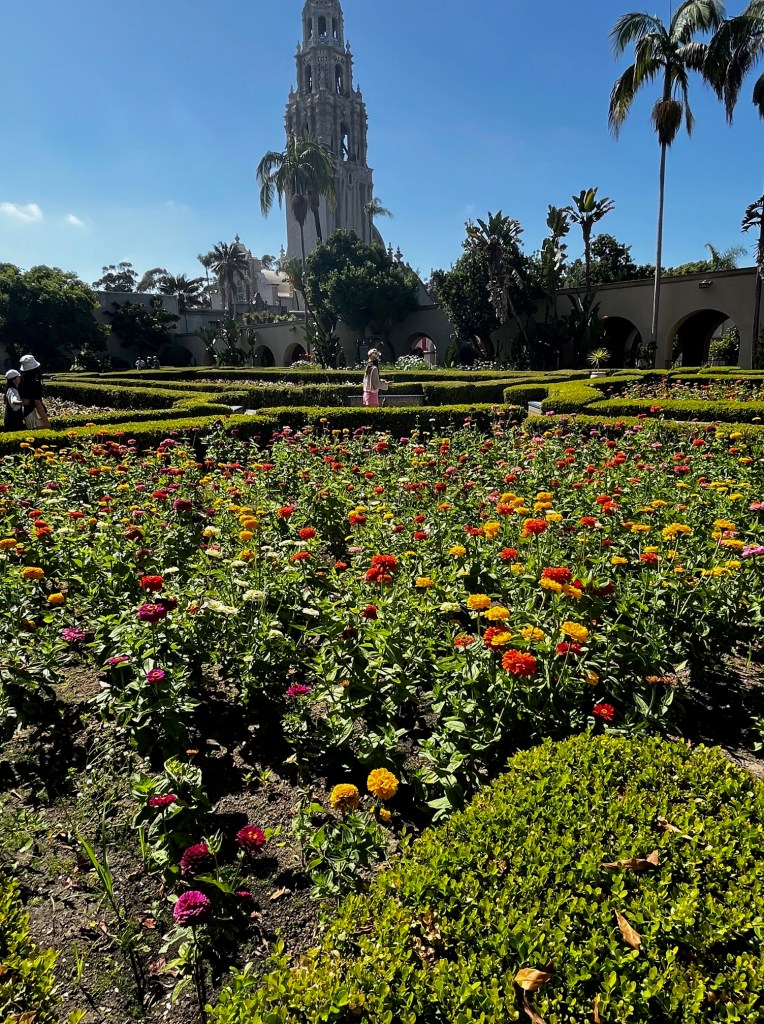
Around Balboa Park.

What I’m up to

I only make chicken soup once or twice a year. It isn’t hard—it’s just tedious, if you do it the traditional way. Boil the chicken in the pot, skim off the fat, skim off more fat, sheesh didn’t I get it all yet? Then add the other ingredients and simmer. Make the matzo balls in a separate pot, then drop them in. Haul out the chicken, leaving some bits for the soup, trying to get all the bones out. You won’t get all the bones out. Eat carefully. But also eat a lot of it, because homemade chicken soup is amazing, especially my mother’s recipe.

We hosted my family’s Passover seder this year, which meant I guided ten people through my slightly abbreviated version of the Haggadah and then served them soup, among other things (did my sister think my mother had made that soup? Yes she DID). It went pretty well. My other sister brought gefilte fish, which I am happy to confirm I still loathe, but my parents and sisters love it so it got eaten.

There was some debate in Jewish publications about whether it was appropriate to celebrate Passover this year, given the state of the world. I respect the thought process behind that, but here’s the thing: During the pandemic, we didn’t see people. Not for Passover, not for Easter (we’re interfaith), not for Hanukkah or Christmas or anyone’s birthdays. My father-in-law died on Easter Sunday 2020 and we couldn’t hold a memorial service for a year. If we’re lucky enough to be able to celebrate events in person now, we’re going to do that. And we’re going to hope for better, calmer days ahead for everyone.

So, here’s what I’m doing lately. I do the occasional fan panels for an all-virtual con called ConTinual and it’s a lot of fun. Here I am talking about Buffy Season 2 and about Good Omens. My next published short story will be in an all-dragons anthology from WolfSinger Publications, and I’ll update that link when the pub date is official. And I’ll be officially receiving the Sydney Taylor Manuscript Award at the AJL conference in June.

Also, I’ve started volunteering for Strong Women-Strange Worlds, a regular virtual showcase for female/nonbinary/underrepresented gender authors of science fiction, fantasy, and horror. It’s a really nice group, and if the above describes you, sign up to do a reading! They’re always looking for more people.

#####

World Central Kitchen is back in Gaza, so it seems like a good time to give them a donation. Other suggestions follow, in no particular order:

Project HOPE offers training and support to health care workers and health care services around the world; it’s helping coordinate delivery of needed equipment, supplies, and services to people in Israel and Gaza

The Alliance for Middle East Peace is a coalition that works to build trust between Israelis and Palestinians; it’s creating emergency shelters, collecting donations, and offering support in other ways

The UN’s World Food Programme supplies food and vouchers to people in Gaza and the West Bank

IsraAID is the largest humanitarian aid group in Israel, according to its site, and it responds to crises worldwide; it’s helping with humanitarian activities and mental health support for Israeli evacuees

The Palestine Children’s Relief Fund has been sending food, water, and medical supplies into Gaza

Sulala Animal Rescue is the only animal rescue shelter in Gaza; it’s raising funds through Animals Australia

National Council of Jewish Women is a women- and family-centered social justice group that’s raising funds to provide basic needs, counseling, and advocacy for women and families impacted by the Hamas attack

Women Wage Peace is a women-led, nonpartisan grassroots group that advocates for a diplomatic solution to the Israeli-Palestinian conflict

Soroka Medical Center is handling the emergency medical response in Israel

The JDC helps Jews and others in crisis around the world

Save the Children is trying to get needed supplies into Gaza

American Friends of Magen David Adom is Israel’s first aid/first responder service

United Hatzalah is a volunteer emergency medical services organization that operates across Israel

Americares is trying to assist with people’s medical and mental health needs in Israel and in Gaza

The International Committee of the Red Cross is providing medical supplies and household items to people in Gaza and trying to advocate for hostages still being held in Gaza

On showing up

At the beginning of my career, way back in the last century, I used to cover meetings. School board, town council, etc. And generally speaking, these public officials were playing to empty rooms. There were usually two or three residents who made a point of going to all the meetings, and a lot of empty chairs around them. Once a school board facing budget cuts suggested dropping, among other things, the late buses that help students get home from after-school activities. A roomful of families showed up at that meeting to tearfully beg them to keep those bus routes. The meeting after that? Empty room again.

It’s essentially the same situation now (with a particular exception; let’s come back to that). When I go to meetings—as a resident, these days, not as a reporter—there might be a few people there with questions for town officials, or people getting awards, or Boy Scouts fulfilling badge requirements. But at many meetings, there are plenty of empty seats.

I mention this because I was at a vigil for Nex Benedict over the weekend, and what the speakers kept saying, over and over, is that people say they’re LGBT allies, say they’re supportive, but don’t necessarily show up at the public meetings where rules or legislation affecting LGBT people are being determined, or where books featuring LGBT people are being banned.

That’s true. Who’s been showing up at public meetings over the past few years? Moms for Liberty, or groups that act like them. They tell school boards in towns they don’t necessarily live in to ban books they may or may not have read, and those books almost invariably feature LGBT characters (except when they feature Black characters dealing with racism, or Jewish characters dealing with antisemitism). And they harass librarians in order to get their way. I wrote about this a few months back. Banning books about LGBT people, or banning a Pride flag raising or “safe space” rainbow stickers in schools, are ways of telling LGBT people they aren’t welcome or they shouldn’t exist.

At that vigil for Nex Benedict, multiple trans or nonbinary speakers said they’d never expected to survive to their thirties, or forties, and they wanted trans and nonbinary kids to know they could make it to adulthood, too. They wanted kids to see there was a future ahead for them.

That’s so poignant, and so important.

People who show up at public meetings are more likely to get what they want from public officials. So attend your local meetings. Make sure you know what’s going on in your town. If you disagree with what public officials are saying or doing, make sure you tell them so. And if members of minority groups are being attacked, show up and show them they’re not alone.

Why I talk about antisemitism

A few years ago—pre-pandemic—I attended a workshop on diversity in children’s literature. Before the workshop leader got started, she had us write down and then share the parts of our identities that made us “diverse,” I think to prove the point that we’re all more diverse than we realize. I hesitated before writing down Jewish. Did that count as diverse? I wasn’t sure. Judaism, or religious minorities generally, never seemed to be part of these discussions, and I hadn’t quite gotten to the point of writing Jewish characters in my fiction. But I shared it anyway.

I don’t remember much of the workshop, except that she said diversity was important, which seemed like a pretty basic thing to agree with. Afterward, I was handing in the post-workshop survey when the leader and I got to talking. She remembered I was Jewish. And she started complaining to me about the Hasidic Jews in Rockland County, NY. Oh, they’re so rude, oh they’re so pushy, oh they’re so etc.

I stood there in shock. What was I supposed to say? Was she telling me this because she expected me to agree with her, or to apologize to her on behalf of “my people”? And hadn’t she just run an entire workshop on the importance of diversity?

I got out of that conversation in a hurry. My only takeaway from that workshop is that I wasn’t supposed to be included in it.

Antisemitism can look a lot of ways, which is why it can be hard for people to recognize it when it’s staring them in the face. One way is to see a secular Jew, think “Hey, she’s one of the cool ones, I can say stuff to her,” and say mean things about more religious Jews. Yeah … please don’t do this. Hasidic Jews, or ultra-Orthodox Jews in general, lead very different lifestyles than I do, but they’re still my fellow Jews and I support them. Especially since they’re a much more visible target for harassment or abuse than someone like me.

Because antisemitism is hard to recognize, I think people don’t always realize how widespread it is. A few months ago, I was at an event chatting with someone who also happened to be Jewish. We started comparing notes on our childhoods, in completely different areas of New Jersey: Oh, you had pennies thrown at you? Me too. Yeah, the kids called me names too. The third person in our conversation, who wasn’t Jewish, listened with increasing astonishment. How did we have such similar experiences? She’d never heard of this sort of thing happening before. Why would children do this?

And because people don’t see this particular form of hatred, it festers and continues.

It’s a fraught time to have this conversation, given current events. But we always need to have this conversation. There will always be another reason, as Dara Horn says (read People Love Dead Jews if you haven’t already), that we need to justify our existence to people.

I started writing my middle grade manuscript—about golems, and magic, and a couple of neurodivergent kids dealing with antisemitism—around 2019. It’s been immensely frustrating watching the manuscript get more relevant every year. I would’ve preferred that it become outdated, and that my kids not have to deal with jokes about Hitler or overhear comments about how “Judaism isn’t a real religion!”

I’d rather not talk about these things. But someone has to talk about these things. Naming problems is the only way to solve them.

Thanks for listening.

***

There are various groups trying to get aid to people in Gaza and in Israel; I don’t know how successful they are right now, but it’s worth helping them. Stay well and stay safe.

Project HOPE offers training and support to health care workers and health care services around the world; it’s helping coordinate delivery of needed equipment, supplies, and services to people in Israel and Gaza

The Alliance for Middle East Peace is a coalition that works to build trust between Israelis and Palestinians; it’s creating emergency shelters, collecting donations, and offering support in other ways

The UN’s World Food Programme supplies food and vouchers to people in Gaza and the West Bank

IsraAID is the largest humanitarian aid group in Israel, according to its site, and it responds to crises worldwide; it’s helping with humanitarian activities and mental health support for Israeli evacuees

The Palestine Children’s Relief Fund has been sending food, water, and medical supplies into Gaza

Sulala Animal Rescue is the only animal rescue shelter in Gaza; it’s raising funds through Animals Australia

National Council of Jewish Women is a women- and family-centered social justice group that’s raising funds to provide basic needs, counseling, and advocacy for women and families impacted by the Hamas attack

Women Wage Peace is a women-led, nonpartisan grassroots group that advocates for a diplomatic solution to the Israeli-Palestinian conflict

World Central Kitchen is feeding displaced families in Israel and working with a local partner in Gaza to distribute meals to Palestinians

Soroka Medical Center is handling the emergency medical response in Israel

The JDC helps Jews and others in crisis around the world

Save the Children is trying to get needed supplies into Gaza

American Friends of Magen David Adom is Israel’s first aid/first responder service

United Hatzalah is a volunteer emergency medical services organization that operates across Israel

Americares is trying to assist with people’s medical and mental health needs in Israel and in Gaza

The International Committee of the Red Cross is providing medical supplies and household items to people in Gaza and trying to advocate for hostages still being held in Gaza

About MdDS

I’ve referenced this vestibular thing I have a couple times but never gone into detail, because 1. I have a pretty mild case and 2. I hate whining. But also I think it’s a good idea to explain the disorder a little more, since most people don’t know about it. (Doctors also. Many of them don’t know about it.)

Mal de Debarquement Syndrome (MdDS or MDD, depending on which source you’re using) or disembarkment syndrome is a vestibular disorder that’s usually triggered by a period of passive motion—meaning, riding on a boat, in a plane, in a car or train. You know that feeling when you’ve been on a boat for a while, and then you get to shore and you still feel like you’re rocking on the waves? You “still have your sea legs,” as they say? Right, so imagine feeling that way all the time. That’s MdDS. Your brain can’t readjust to being on land, so your sense of balance is off.

For me—again, I have a mild case, and it’s only recently come back after several years of remission—it feels like the world is occasionally rocking around me, as though I’m on a boat, and sometimes I get a little fogbrained and tired. It was more intense in 2020, the first time I got it, apparently triggered by a plane ride and an extra-long car ride on snowy roads. That time, I felt like walking was more difficult, and the symptoms were constant. I’ve had three rounds of this so far, and each time I’ve gone from regular symptoms to maybe-every-other-day symptoms to nothing. This usually takes about six months. Right now I’m in the intermittent phase, which is good because I got there quicker than usual.

People who have severe cases, say they’re at a 9 or a 10 on the symptom scale, can’t really function at all. Some people have symptoms for years, or forever. There isn’t a cure, but there is a disability code for it. Bonus: Many people have doctors telling them it’s all in their heads. (I’m in an online support group for this. The stories people tell are awful.)

You know it’s MdDS and not vertigo or a similar disorder if you feel fine while you’re in passive motion, meaning in a car, on a plane or train, etc., and the symptoms come back once you’re back on solid ground. You also probably won’t feel dizzy or nauseous; this isn’t motion sickness. It’s the earth in perpetual motion around you.

MdDS is an official rare disease, meaning that if you think you have it, you have to explain to your doctor what it is before they can recommend treatment. (Ask me how I know!) Treatment can involve medication, usually SSRIs, or vestibular rehabilitation therapy, which is offered at some physical therapy facilities. I did vestibular rehabilitation for a few weeks in 2020, right before the whole world shut down, and I still have my list of at-home exercises to do as needed. There are also ways to manage or lessen MdDS symptoms, say by using walking sticks or canes if walking is difficult. I wear EarPlanes during flights; they’re basically earplugs that you screw into your ears during takeoffs/landings to lessen the severity of the noise and air pressure. Yes they look ridiculous, no I don’t care.

If you’re interested in learning more about it, or if you think you or someone you know has this weird thing, the MdDS Foundation offers a useful website. It’s how I realized I had MdDS in the first place. And this year’s Rare Disease Day will be marked worldwide on Feb. 29, in case you want to get involved.

The way I figure, if it’s a rare disorder that doctors don’t always recognize, then there are people who have it and don’t know what’s wrong with them. Which is why I’m writing about it. Hoping this is helpful to someone out there.